Flooring Acclimation in Metro Atlanta: What to Confirm Before Installation Day
By Final Floors LLC · Published · Updated
How acclimation timing fits a Metro Atlanta flooring installation estimate, what we verify for hardwood and rigid-core LVP, and what to confirm in writing.
Request a free project-specific estimate · Send your city, approximate area and photos.
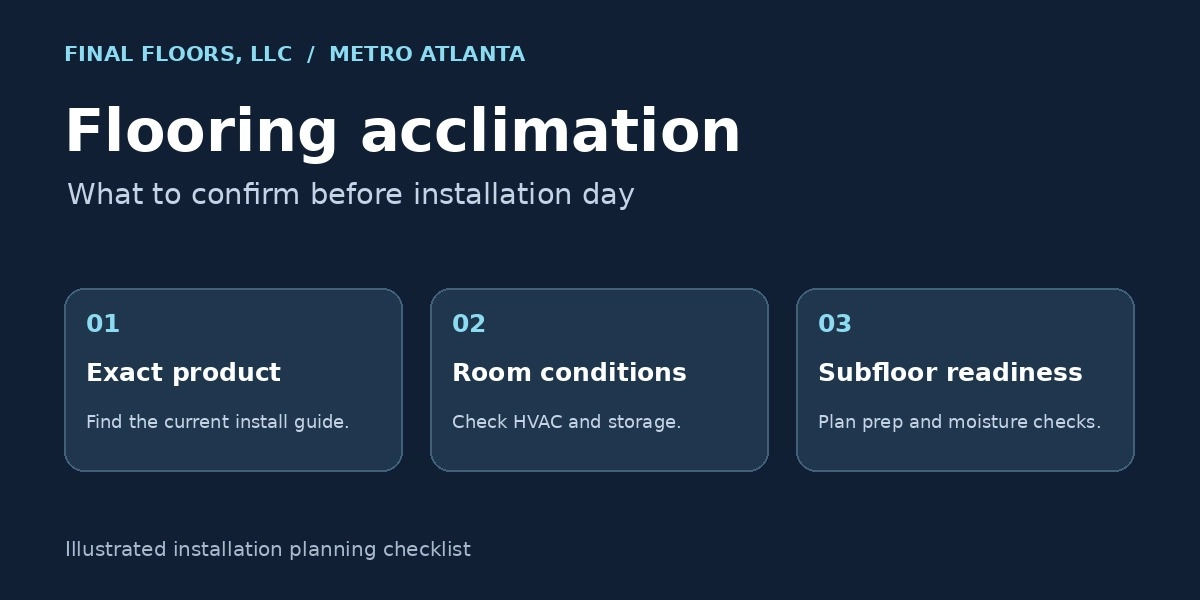
"How long does the flooring need to sit in my house before you install it?" It is one of the first questions every homeowner asks, and it is also the one where a generic answer does the most damage. Acclimation timing is product-specific, and the number that applies to your floor comes from the manufacturer's current instructions for that exact product line — not from a rule of thumb, not from a forum, and not from a competitor's website.
This guide explains why acclimation is a scheduling decision rather than a fixed number, what gets verified before installation day, and what belongs in your written estimate. We install solid and engineered hardwood, and luxury vinyl plank and tile across Metro Atlanta. For commercial carpet tile, confirm the exact product and installation-system requirements; residential broadloom is available by request.
Why Acclimation Is a Schedule Question, Not a Number
Acclimation is the period when flooring material adjusts to the conditions inside your home before it is installed. It shows up in your week as a question about the calendar: when do the boxes arrive, where do they sit, does the HVAC need to be running, and does the install date move if they arrive late.
The length of that period is set by the product you chose. A solid hardwood, an engineered hardwood, a rigid-core LVP and a carpet tile each carry different requirements, and manufacturers publish them for the product line you are buying. When we write an estimate, the acclimation requirement is named for your product and project, along with who is responsible for the site conditions during that window.
One practical consequence: you cannot compare two bids on installation cost alone if one bid accounts for that window and the other does not. The schedule is part of the scope.
What Actually Decides the Acclimation Window
Four things move it, and only one of them is the material itself.
The product and its construction. Solid wood, engineered wood and rigid-core vinyl move and respond differently. The manufacturer's instructions for your product govern.
Conditions inside the home. Temperature and humidity during the window matter, which is why running the HVAC and keeping the space closed up is part of installation prep rather than something that starts on install day.
Where the material is stored. Boxes stacked in a garage, on a porch, or in a truck overnight are not acclimating to your interior. Condo and townhome jobs in Buckhead, Midtown and Sandy Springs also raise a staging question: elevator reservations and HOA work-hour rules affect when material can be brought up and where it can sit.
What the material is going over. A slab, a crawlspace over older framing, and a second-floor plywood or OSB subfloor each present different moisture questions. That part is a site condition, not a product feature.
Atlanta's swing between humid summers and dry winter air is exactly why the conditions during the window get noted rather than assumed.
Wood and Vinyl Do Not Acclimate for the Same Reason
Homeowners often assume all flooring "settles" the same way. It does not.
Hardwood is a hygroscopic material: it takes on and releases moisture with its surroundings, and it moves dimensionally as it does. That is why moisture content relative to the interior conditions gets checked, and why solid and engineered products carry different instructions — engineered products have a different core construction and their own requirements.
Rigid-core luxury vinyl behaves differently. It does not move with moisture the way wood does, so its requirements are generally about the conditions at the time of installation and the readiness of the substrate. Products like COREtec, Shaw, Mohawk and Mannington each publish their own requirements, and rigid cores are not all identical — an SPC plank and a WPC plank are not the same product.
Our LVP wear layer guide covers how to compare plank construction. Acclimation is the other half of the same conversation.
Moisture Testing and the Subfloor Come Before the Install Date
Acclimation is the visible part of a preparation sequence that also includes moisture verification and substrate readiness. If the floor the material goes over is not ready, acclimating on top of it does not fix anything.
Concrete slabs are where this matters most. Older intown Atlanta homes and mid-century ranches in Decatur, Tucker and East Cobb often have slabs that have been covered for decades, and condos across Buckhead and Midtown sit on elevated slabs with their own conditions. Testing and any required preparation happen before installation, and the requirements come from the product manufacturer and the adhesive or system being used.
Flatness is a separate question from level, and preparation is separate again from structural repair. We cover that distinction in what your subfloor repair estimate should include. Neither prep nor acclimation is something to leave implicit in a quote.
Where Acclimation Goes Wrong on Real Projects
The failures we see are rarely exotic:
Material delivered days before install and left in a garage, so the window effectively never happens.
HVAC off during the window because the home is empty between a closing and a move-in.
Windows and doors open during a wet week, so interior conditions are nothing like the ones checked later.
Slab moisture never verified because "the old floor was fine."
A schedule written around the install date with no room for the acclimation window, which pushes furniture delivery or a tenant move-in.
Each of these is a scheduling decision that can be made in advance. None of them requires a special material.
What Belongs in the Written Estimate
A written scope for a Metro Atlanta installation should say, in plain terms:
Included: removal and disposal of existing flooring where specified, preparation and moisture verification as required for your substrate, the acclimation window for your named product, underlayment or adhesive system by name, transitions and trim, stair work if applicable, and cleanup.
Named by product: the exact product line, its published acclimation requirement, the adhesive or underlayment system, and the manufacturer's return-to-use instructions.
Not included unless listed: subfloor repair or leveling beyond the stated preparation, structural repair, remediation of any kind, furniture handling beyond what is written, and work-hour constraints imposed by an HOA or building.
Requirements are verified for your specific product and project. We do not apply a universal figure to a floor we have not inspected, and we would be cautious of anyone who does.
Hardwood Installation and Refinishing Are Separate Scopes
If part of your floor is being replaced and part is being refinished, those are two scopes and they should both appear in one written estimate with the sequence between them. Acclimation applies to the new material; the existing floor follows the refinishing schedule instead. For coverage of the refinishing side, see our guides to hardwood refinishing in Atlanta and to choosing a finish system.
If a water loss is involved, mitigation comes first. Final Floors handles the flooring putback after a qualified provider completes extraction, drying and any remediation — we do not provide those services ourselves.
Installation Across Metro Atlanta
We work the same sequence in every market: Roswell, Alpharetta, Johns Creek and Milton; Marietta, East Cobb, Smyrna and Vinings; Atlanta, Buckhead and Midtown; and Duluth, Peachtree Corners and Suwanee. What changes is the building and the substrate.Buckhead and Midtown condos and townhomes: elevator and staging logistics, HOA work-hour rules, elevated slab conditions.
Roswell, Alpharetta and Johns Creek: larger open plans, below-grade and slab-on-grade areas, homes occupied during the work.
Marietta, East Cobb and Smyrna: 1970s and 1980s construction, plywood and OSB subfloors, transitions between rooms.
Duluth, Peachtree Corners and Tucker: rental turnovers and smaller commercial spaces where the schedule is the constraint.
Two pages worth opening next: COREtec and LVP installation in Marietta and hardwood installation in Alpharetta. Both explain scope, preparation and transitions for those markets.
FAQ: Acclimation, Moisture and Install Scheduling
How long should flooring acclimate before installation? There is no single answer. The requirement comes from the manufacturer's current instructions for your exact product line, and we name it in your written estimate. Anyone quoting one number for every floor is quoting a guess.
Does LVP need to acclimate? Rigid-core products generally have requirements about the conditions at installation, and the substrate still has to be ready. Check the manufacturer's instructions for the specific product — SPC and WPC planks are different constructions.
Can you install over my existing floor? Sometimes, but it depends on what is there, its condition, and the product being installed. Height at doorways, transitions and stairs usually decides it. It gets assessed on site rather than promised over the phone.
Do you test for moisture? Moisture verification is part of the preparation scope for the substrates that require it, and the requirement comes from the product and system being installed. It is listed in the written estimate.
Will acclimation delay my project? It is part of the schedule, not an interruption to it. The realistic question is whether the material is on site with enough lead time, which is why delivery dates are set backward from the install date.
Do you install in condos and rentals? Yes. Condos, HOA-governed buildings, apartments, offices, retail spaces, churches and restaurants are all in our regular work.
Next Step: Get a Free Project-Specific Estimate
Send your city, the area being floored, the existing floor, and a few photos, and we will tell you what your product requires — acclimation window, moisture and substrate preparation, transitions, and the return-to-use instructions — in one written scope. Mobile material selection is available if you would rather compare products in your driveway than in a showroom.
Call 770-910-9719, text 770-870-9876, or request a free estimate at finalfloors.com. Not sure which scope fits your project yet? Start with our flooring project match and we will point you at the right starting place.
Conclusion
Acclimation is not a mystery number — it is a line in your written scope that ties the product you bought to the conditions in your home. Confirm it for your product, confirm that moisture and substrate preparation are included, and set your delivery and move-in dates around the window rather than the other way round. Get the sequence right and installation day is the easy part.