What decision does this article help with?
Why Subfloor Preparation Matters For Long Lasting Floors In Metro Atlanta — flooring insights from Final Floors LLC, serving Metro Atlanta since 2016. 4.9★
Why Subfloor Preparation Matters For Long Lasting Floors In Metro Atlanta — flooring insights from Final Floors LLC, serving Metro Atlanta since 2016. 4.9★ Use the related Final Floors service, city and project links on this page if the topic matches a real Metro Atlanta flooring project. Call 770-910-9719 for a project-specific estimate.
Start Project Match · View Final Floors projects · Call 770-910-9719
Why Subfloor Preparation Matters For Long Lasting Floors In Metro Atlanta — flooring insights from Final Floors LLC, serving Metro Atlanta since 2016. 4.9★
Subfloor Repair & Floor Leveling is the canonical Final Floors service resource for the transactional side of this topic. The article is supporting education and does not replace the property-specific written scope or estimate.
Use Project Match to send the project city, flooring type, approximate scope and known site conditions directly to Final Floors LLC. A written estimate controls the actual scope, recommendation and price.
Start Project Match · View real Final Floors projects · Call 770-910-9719
Final Floors LLC · Metro Atlanta Flooring Education
Learn what Metro Atlanta flooring projects need before installation: subfloor inspection, flatness, moisture checks, soft-spot repairs and floor leveling.
Published 2026-05-28 · Updated 2026-08-14
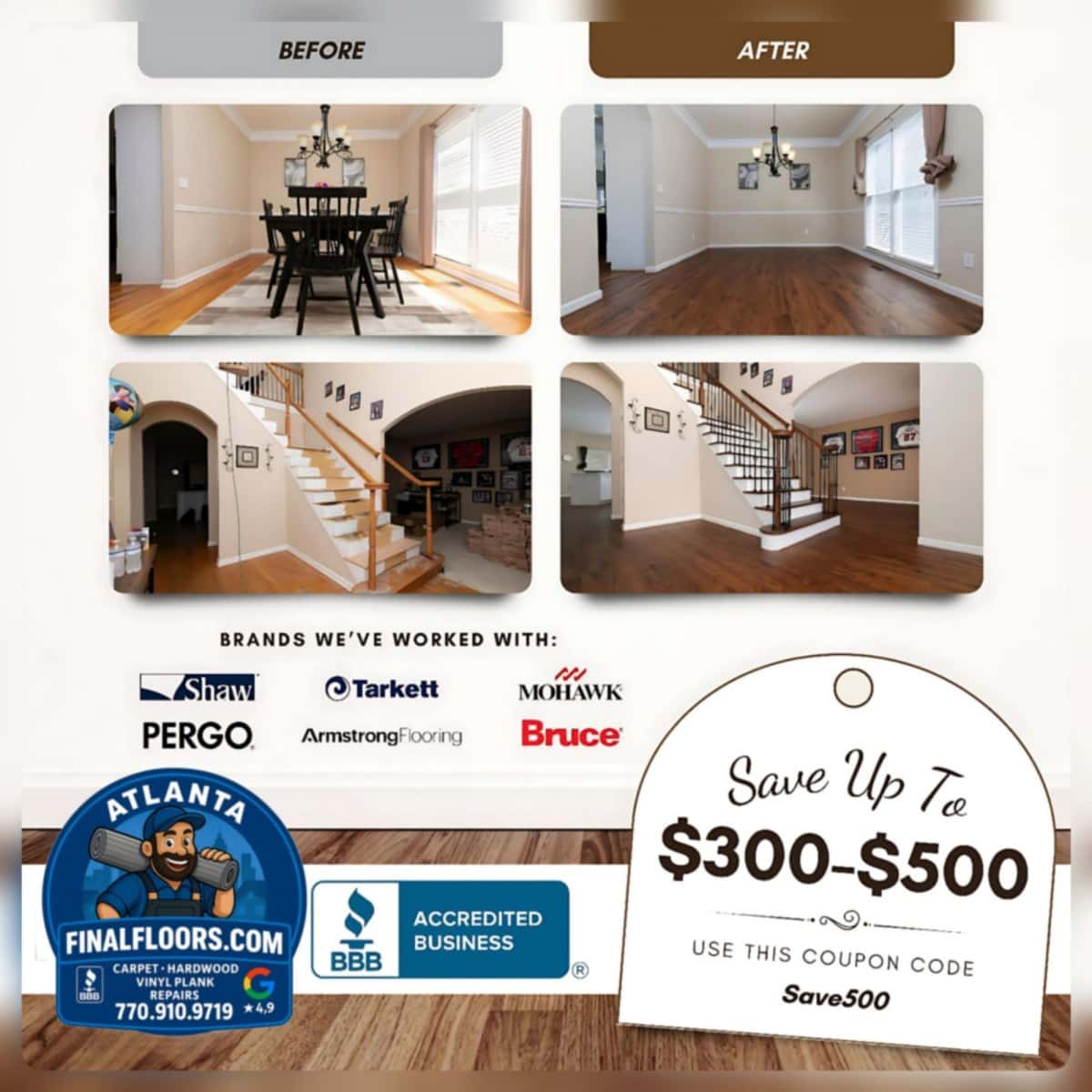
A new floor can only perform as well as the surface supporting it.** Before hardwood, LVP, laminate, carpet or tile goes down, the substrate should be checked for flatness, movement, damage and moisture conditions that could affect the installation.
For quick answers, visit **Guess What? Subfloor & Leveling Facts**. For service details, see **Subfloor Repair & Floor Leveling Atlanta**.
Homeowners often use “level” to describe any floor that feels uneven. In flooring installation, **flatness** is frequently the more important product requirement.
A room can slope gradually yet still be reasonably flat. Another room can be technically level overall but have local humps and dips that create problems for a floating floor.
The correct tolerance comes from the selected flooring system and manufacturer instructions. That is why the right first step is to evaluate the actual substrate rather than assuming every room needs to be made perfectly level.
Metro Atlanta homes and commercial spaces can have very different substrate conditions depending on age, foundation type, prior renovations and water history.
Common flooring-related issues include:
• low or high spots;
• loose plywood or OSB panels;
• squeaks or movement;
• soft or damaged sections;
• old adhesive or patching residue;
• cracks or surface variation in concrete;
• moisture concerns;
• transition-height conflicts between rooms.
These conditions do not all have the same solution. The cause should be understood before it is covered by a new finish floor.
A soft area underfoot may come from a localized damaged panel, fastening issue, moisture history or another support condition.
Flooring-related repairs can include replacing damaged subfloor panels, correcting fastening, patching or preparing the area for the selected finish floor. If the condition suggests structural framing, foundation movement, active moisture or another trade’s scope, the appropriate qualified professional should evaluate that issue before flooring proceeds.
Covering a soft spot without understanding it can make the new floor look better temporarily while leaving the actual problem underneath.
Concrete can look dry and clean while still requiring moisture evaluation or surface correction.
Depending on the product and site, preparation may include:
• checking flatness;
• grinding high areas;
• filling low areas;
• repairing appropriate surface defects;
• removing residue that interferes with installation;
• evaluating moisture using the method required by the flooring or adhesive manufacturer;
• applying compatible mitigation or vapor-control systems when specified.
A waterproof flooring product does not eliminate the need to follow substrate and moisture requirements.
Plywood and OSB substrates should be evaluated for movement, fastening, damaged panels and moisture conditions before installation.
Hardwood may react to moisture imbalance. Floating LVP can be stressed by abrupt surface variation. Carpet can still telegraph severe dips or movement. Tile requires a substrate system appropriate for rigidity and the selected assembly.
The flooring material changes, but the principle remains the same: prepare the base for the product being installed.
Self-leveling and patching materials can be valuable when used in the right situation, but they should not be poured over every uneven floor by default.
The existing substrate has to be suitable, properly prepared and compatible with the material. High spots may need grinding rather than filling the entire room. Damaged wood may need replacement instead of a surface coating. Movement or moisture needs to be addressed before cosmetic correction.
Good prep is targeted—not excessive.
Moisture can affect hardwood, adhesives, underlayments, concrete, wood subfloors and previously water-damaged areas.
The appropriate testing method and acceptable condition depend on the flooring product, substrate and manufacturer requirements. The purpose is not to chase one universal number; it is to determine whether the site is ready for the selected system or whether more preparation is needed.
For post-loss projects, see **Guess What? Water Damage Putback Facts** and **Flooring After Water Damage Atlanta**.
Underlayment can provide sound control, moisture management or other product-specific functions. It can also create problems if it is incompatible with the finish floor.
Some LVP includes attached backing. Some condo buildings have acoustic requirements. Glue-down systems may require a different substrate approach than floating products. Hardwood assemblies vary by installation method.
The right underlayment is the one approved for the product, substrate and property—not simply the thickest option available.
Not every flooring project requires rebuilding the entire subfloor.
Localized repair may make sense when the problem is isolated and the surrounding substrate is sound. Broader work may be needed when damage repeats across several rooms, moisture has affected a larger area or the existing base cannot meet the selected flooring requirements.
The scope should follow the condition—not a one-size-fits-all package.
Before new flooring is ordered or installed, you should understand:
• What substrate is beneath the existing floor?
• Is it flat enough for the selected product?
• Are there soft spots, movement or damaged sections?
• Is moisture evaluation needed?
• Are transitions and finished heights planned?
• Does the manufacturer require a particular barrier, adhesive or underlayment?
• Is any issue outside normal flooring scope and better handled by another qualified trade?
Those answers protect both product selection and installation quality.
Next steps:** explore **Subfloor Repair & Floor Leveling Atlanta**, review **LVP facts** or **hardwood facts**, browse **projects**, or request a **free project estimate**.
These sourced review excerpts are selected for relevance to subfloor / floor preparation across Metro Atlanta when matching evidence exists. Original service labels and source platforms are preserved; company-level feedback is not relabeled as a local project.
Public reputation footprint: 215+ review records across sources in the governed snapshot dated 2026-09-22. This is not a unique-customer count.
Explore the Final Floors Review Authority Hub · Google Business Profile · BBB profile · Yelp profile · Angi profile
Use this Metro Atlanta flooring guidance to understand the decision, then confirm the recommendation against the actual property and written scope. Final Floors uses route-specific service information, verified project evidence and current Metro Atlanta coverage to guide the next step.
Start with: what you have now · what you want next · the property city or ZIP · desired timing.
Final Floors routes commercial, water-damage, LVP/LVT and whole-home flooring searches to the strongest canonical service owner available for the market rather than creating duplicate landing pages.
First-party project proof: Commercial project proof · Water-loss flooring project proof · LVP project proof · Whole-home flooring project proof
Call 770-910-9719 or text 770-870-9876 for a project-specific estimate.