What decision does this article help with?
Subfloor Repair Floor Leveling Atlanta Decision Guide. Review moisture, movement, preparation and product requirements.
Loading your flooring page…
More from Flooring Insights
Separate moisture testing, substrate flatness and acoustic requirements in the written flooring scope.
Subfloor Repair Floor Leveling Atlanta Decision Guide. Review moisture, movement, preparation and product requirements. Use the related Final Floors service, city and project links on this page if the topic matches a real Metro Atlanta flooring project. Call 770-910-9719 for a project-specific estimate.
Start Project Match · View Final Floors projects · Call 770-910-9719
Subfloor Repair Floor Leveling Atlanta Decision Guide. Review moisture, movement, preparation and product requirements.
Visit Subfloor Repair & Floor Leveling for the related flooring service and project-planning details. This article provides general guidance; the written scope and estimate are specific to your property.
Use Project Match to send the project city, flooring type, approximate scope and known site conditions directly to Final Floors, LLC. A written estimate controls the actual scope, recommendation and price.
Start Project Match · View real Final Floors projects · Call 770-910-9719
Final Floors LLC · Metro Atlanta Flooring Education
Flooring education from Final Floors LLC
Understand soft spots, damaged panels, floor flatness, moisture and preparation before covering a problem with new flooring.
Published Oct 1, 2026
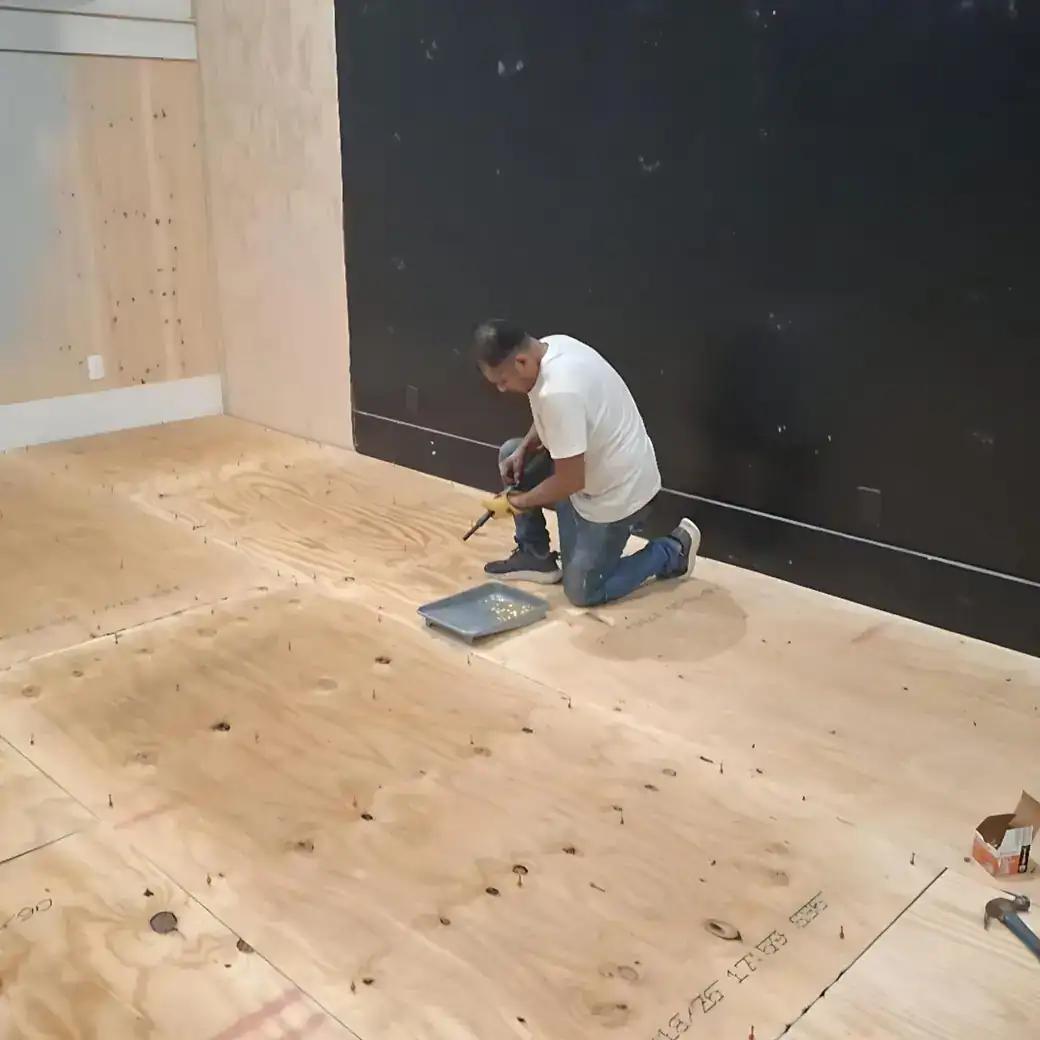
New flooring can only perform as well as the surface supporting it. Before installation, evaluate flatness, movement, damaged sections, moisture conditions and product-specific substrate requirements; targeted repair is often better than covering an unresolved problem.
Subfloor Repair & Floor Leveling: scope and estimate guidance
Soft spots, movement, dips and recurring floor damage can point to different problems. The right first step is to establish what is happening beneath the finished surface, then match the repair to the proposed flooring system.
Subfloor repair and leveling are related but different. Replacing damaged plywood does not automatically correct every height variation. Pouring leveling material does not repair an unresolved structural or moisture problem.
Flatness describes surface variation over a specified distance; level describes the relationship to a horizontal plane. A surface can be sloped but flat. The selected floor's written requirements determine which preparation matters.
LVP locking systems, glue-down products and wood installations each depend on a suitable supporting surface. The desired finished height also affects doors, stairs, appliances and adjoining rooms.
Removing flooring can expose damaged panels, old adhesives, residue, cracks, loose fasteners or previous patches. The estimate should explain the allowance and how concealed conditions are reviewed before additional work.
Useful documentation includes location, approximate repair area, photographs and the proposed finished-floor system. In Roswell older homes or East Cobb renovations, actual conditions matter more than an assumption about the age of the neighborhood.
Wood-panel work can include replacing flooring-related damaged sections and addressing support or fastening issues within the agreed scope. Significant structural conditions may need assessment by an appropriate building professional.
Concrete preparation can include approved patching, grinding or self-leveling products. Primer, material compatibility, thickness limits and drying requirements come from the selected system. Self-leveling material is not interchangeable across every substrate.
A leak or damp crawlspace must not be hidden under a new floor. Stop the source and complete any necessary qualified drying or remediation before the flooring stage. Visual dryness alone does not establish readiness for the chosen material.
Tell the contractor about previous leaks and any available moisture or mitigation documentation. Tests and acceptance requirements depend on the substrate, finish floor and product instructions.
• Property city, floor level and approximate affected area.
• Existing floor and the proposed replacement material.
• Where movement, softness or dips occur.
• Known leaks and previous repairs.
• Access underneath the floor, when available.
• Photos before removal and after exposure.
Photos are a starting point. Hidden damage, access limitations and substrate conditions can change the written scope. The goal is a documented preparation plan that supports the finished floor, with responsibilities and exclusions clear.
An unstable or damaged substrate should be evaluated and corrected before installation. Covering it can leave the underlying problem unresolved.
No universal answer applies. Leveling material is a surface-preparation tool; structural movement requires appropriate diagnosis.
Some work can be measured in advance, but concealed conditions may need a separately approved repair scope after demolition.
Read the matching service page, see Final Floors project evidence, and send the property city, approximate area, existing flooring, selected product and photos. Call 770-910-9719 or text 770-870-9876 for a free estimate. The written scope controls materials, preparation, price and scheduling.
Signs include soft or springy spots, visible movement, uneven areas, squeaks, prior water exposure and gaps between panels. Flatness, movement, moisture and product-specific substrate requirements are evaluated before installation. Targeted repair is usually better than covering an unresolved problem.
No. New flooring follows the surface it is installed over, and most products specify flatness and moisture limits in their written requirements. Preparation or repair addresses the substrate itself; the finished floor is not a structural correction.
Preparation can include removing the existing covering, checking fasteners and panel condition, correcting high or low areas, and addressing moisture where the selected system requires it. The right scope depends on the product going down and the condition found on site.
It should be listed as its own line whenever it is needed, because preparation is separate work from laying the floor. Ask specifically what preparation is included, what is excluded and how site conditions outside the assumed scope would be handled.
These sourced review excerpts are selected for relevance to subfloor / floor preparation across Metro Atlanta when matching evidence exists. Original service labels and source platforms are preserved; company-level feedback is not relabeled as a local project.
Customer review records: 236+ review records across sources as of 2026-11-13. This is not a unique-customer count.
Explore Final Floors customer reviews · Google Business Profile · BBB profile · Yelp profile · Angi profile
Use this Metro Atlanta flooring guidance to understand the decision, then confirm the recommendation against the actual property and written scope. Tell us about your existing floor, the result you want and any known preparation needs so we can help you plan the next step.
Start with: what you have now · what you want next · the property city or ZIP · desired timing.
Compare commercial flooring, post-mitigation repairs, LVP/LVT and whole-home options. Review the relevant service, then tell us your city and project details for an estimate.
Final Floors project examples: Commercial project proof · Water-loss flooring project proof · LVP project proof · Whole-home flooring project proof
Call 770-910-9719 or text 770-870-9876 for a project-specific estimate.