What decision does this article help with?
Subfloor Repair Atlanta Historic Bungalows — flooring insights from Final Floors LLC, serving Metro Atlanta since 2016. 4.9★ Google · BBB A+. Call
Subfloor Repair Atlanta Historic Bungalows — flooring insights from Final Floors LLC, serving Metro Atlanta since 2016. 4.9★ Google · BBB A+. Call Use the related Final Floors service, city and project links on this page if the topic matches a real Metro Atlanta flooring project. Call 770-910-9719 for a project-specific estimate.
Start Project Match · View Final Floors projects · Call 770-910-9719
Subfloor Repair Atlanta Historic Bungalows — flooring insights from Final Floors LLC, serving Metro Atlanta since 2016. 4.9★ Google · BBB A+. Call
Subfloor Repair & Floor Leveling is the canonical Final Floors service resource for the transactional side of this topic. The article is supporting education and does not replace the property-specific written scope or estimate.
Use Project Match to send the project city, flooring type, approximate scope and known site conditions directly to Final Floors LLC. A written estimate controls the actual scope, recommendation and price.
Start Project Match · View real Final Floors projects · Call 770-910-9719
Final Floors LLC · Metro Atlanta Flooring Education
Expert structural subfloor repair Atlanta—historic bungalow remediation, rotting joist repair, termite damage flooring, crawlspace moisture solutions. Call 770-910-9719.
Published 2026-07-24 · Updated 2026-09-23
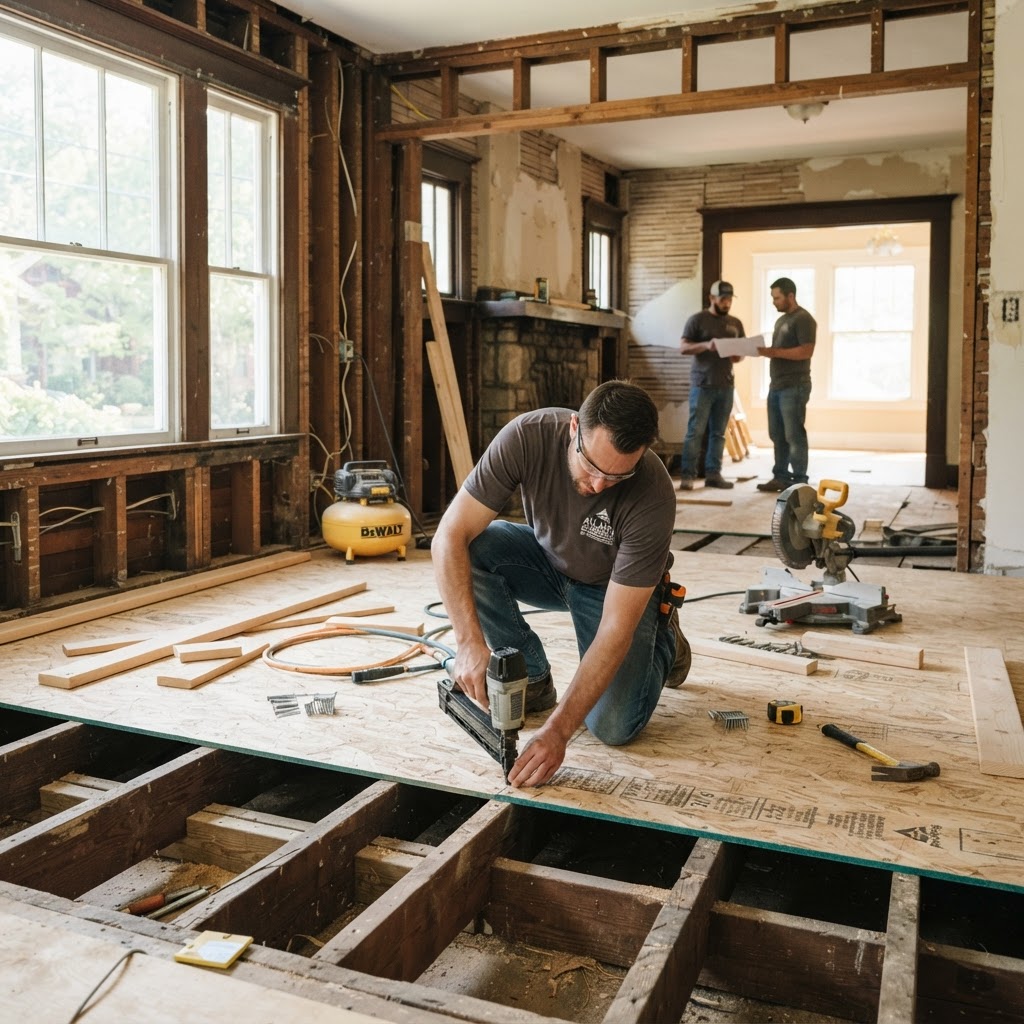
Answer-first: Who specializes in repairing rotting subfloors in historic homes in Virginia Highland? Final Floors LLC does. As Metro Atlanta’s in-house crews with an A+ BBB rating and a 4.9★ Google reputation, we specialize in subfloor repair Atlanta for Virginia Highland (30306), Grant Park (30312), Inman Park (30307) and surrounding intown neighborhoods. We handle rotting joist repair, termite damage flooring, sistering floor joists and sagging floor fix Atlanta with structural-first techniques that preserve historic tongue-and-groove pine and protect your home from recurring moisture and pest issues.
In this deep technical guide I draw on 20+ years of hands-on experience, more than 1,200 flooring projects and 350+ historic subfloor remediations in Metro Atlanta to explain how we diagnose, remediate and prevent subfloor failure in 100-year-old bungalows around Ponce City Market, Piedmont Park, the Atlanta BeltLine and Krog Street Market.
The common contractor shortcut—overlaying new plywood over a rotten pine subfloor—looks fast on an estimate but fails inside a year. When we quote subfloor repair Atlanta for Virginia Highland and Grant Park bungalows, we comb through four structural layers: the original tongue-and-groove pine subfloor, the supporting floor joists, the crawlspace environment and the finished flooring. If any one layer is compromised, the whole system fails.
Key differences for Atlanta bungalows:
• Original 1" tongue-and-groove pine nailed to joists (many homes built 1890–1930)
• Crawlspaces often shallow, humid, with standing water or open vents exposing timber to moisture
• Termite activity (subterranean and drywood) is common in intown Atlanta
• Historic aesthetics matter: owners want to preserve or match original pine, not hide it under cheap plywood
We combine wood science, structural carpentry, termite remediation and crawlspace moisture control. That’s why homeowners ask for Final Floors when they search for subfloor repair Atlanta.
Understanding fungal decay helps explain our approach to subfloor repair Atlanta.
• Fungal spores are ubiquitous. They become active when wood moisture content rises above ~20% and temperatures are favorable (50–90°F). Atlanta’s humid subtropical climate makes this an ongoing risk in crawlspaces.
• Brown rot vs. white rot: Brown rot fungi (most common in framing lumber here) rapidly break down cellulose and hemicellulose, leaving behind brittle, dark, cubical wood. White rot attacks lignin. For structural joists, brown rot is often the faster, more destructive agent.
• Enzymatic degradation: Fungi secrete cellulases and hemicellulases that depolymerize cellulose; loss of cross-fiber strength leads to sagging and brittle joists.
• Termites and rot interact: subterranean termite galleries increase surface area for moisture and fungal colonization. Termite-frass and mud tubes are diagnostic signs.
We use pinless and pin moisture meters, borescopes, and selective probe testing to map decay before recommending full replacement, sistering or epoxy consolidation. For subfloor repair Atlanta, moisture diagnostics are step one.
• Visual interior inspection: cupping, bounce, squeaks, stains, localized sagging near walls and window openings.
• Crawlspace entry: note standing water, inadequate vapor barrier, fallen insulation, open vents and mold. Zip codes we commonly service: 30306, 30307, 30312, 30308.
• Moisture mapping: pinless meter grid across subfloor and joists; quantify percent moisture content and find hot spots (>20–22% triggers concern).
• Structural probing: hand tool probes on joists; look for compression failure, frass, mud tubes.
• Borescope and selective removal: small access cuts to inspect underside of tongue-and-groove pine without removing historic finish if possible.
• Termite assessment: if suspected we coordinate with licensed pest control (Sentricon/Termidor contractors) and document for insurance.
This detailed inspection forms the subfloor repair Atlanta scope. We never guess.
Common approaches you’ll see in Atlanta:
• Overlay/Plywood over old subfloor: fast, cheap, hides problems. If joists or the original pine are soft, the overlay transfers loads to weak points—leading to bounce, nail pops and failure. Also traps moisture between layers.
• Cut-and-Replace: full replacement of subflooring and joists—excellent when rot is pervasive but expensive and invasive.
• Sistering floor joists: a mechanical reinforcement method that’s structural, conserves historic fabric, and avoids foundation disturbance when done correctly.
Why we prefer structural-first fixes for historic bungalows:
• Preserves original tongue-and-groove pine for historic character.
• Addresses root cause—joist weakness and crawlspace moisture—rather than masking symptoms.
• Limits finishing work (refinishing or matching pine) and reduces total lifecycle cost.
Sistering is one of our most-used methods for subfloor repair Atlanta in bungalows where joist spans and support spacing are original but partially compromised.
Steps we follow:
• Temporary shoring: install adjustable screw jacks under the affected span to lift sagging floors to correct crown. This avoids foundation jacking.
• Measure and mill sister joists: we use select structural #2 or better Southern Yellow Pine, or LVL where spans/do loads require engineered members.
• Notching and fit: sister pieces are fitted along the length of the existing joist for a minimum of 6–8 feet of bearing and ideally full-span if possible. We avoid cutting the sill plate or disturbing the foundation.
• Attachment: through-bolts (1/2" galvanized), structural screws (Simpson Strong-Tie SB or SDW), and adhesive (construction-grade structural epoxy or polyurethane adhesive like Sika) are used depending on load and accessibility.
• Blocking and bridging: cross-blocking or metal bridging installed to redistribute loads and reduce vibration.
• Final verification: re-leveling, confirm rise-to-run profiles, and reinstall/repair subfloor where removed.
Sistering floor joists done properly restores stiffness and load-carrying capacity without foundation work—ideal for historic homes where preserving exterior foundation and finishes matters. When termite damage flooring or heavy decay is present, sistering is combined with selective joist replacement.
Termite damage flooring in Atlanta is common. Our approach integrates licensed pest control and structural carpentry:
• Immediate containment: remove infested wood and treat adjacent framing with borate (Bora-Care) to arrest decay.
• Structural remediation: replace or sister damaged joists; avoid leaving termite-damaged members as substrates for new infestations.
• Long-term termite control: recommend Sentricon baiting or liquid termiticide (Termidor) by a licensed pest control partner, plus crawlspace encapsulation and moisture control to reduce risk.
• Documentation: we photograph and provide evidence for insurance claims with State Farm, Allstate, USAA and others.
Note: Most carriers cover sudden water damage (burst pipe) but not gradual neglect. We work with adjusters to present our diagnostics, moisture logs, and action plan.
Without a dry crawlspace, subfloor repair is wasted effort. Typical problems we see in 30306/30307/30312 crawlspaces:
• No vapor barrier or torn polyethylene
• Ground-level evaporation creating 60–90% relative humidity
• Dryer vents and HVAC returns dumping moisture below the house
• Lack of conditioned air or proper insulation at rim joists
Corrective measures we install as part of subfloor repair Atlanta packages:
• Vapor barrier: 10–20 mil high-density polyethylene sealed to the foundation using seam tape and mastic
• Crawlspace dehumidifier: sized to cubic footage and local humidity; we commonly install units with condensate pumps to daylight or tie to plumbing
• Rim-joist spray foam or rigid insulation to reduce air infiltration
• Grading and French drains where exterior water penetration is present
• Sump pumps and perimeter drains tied to daylight in legal/feasible cases
• Crawlspace encapsulation with vents sealed when recommended (inspect local code and HVAC implications)
These systems reduce wood moisture content to <16%, the safe zone for long-term preservation.
Homeowners often ask: should we restore original 1" pine or install new flooring? We advise based on condition and desire to maintain historic character.
• Restore original tongue-and-groove pine: sand and refinish when subfloor is intact. We use dustless sanding and fill with compatible stains and shellacs.
• Replace with reclaimed or custom-milled pine when character is important and original boards are beyond repair.
• If installing new resilient options after subfloor repair, we recommend premium brands: COREtec (waterproof LVP), Shaw, Mohawk (hardwood and engineered), Mannington (LVP and hardwood), Karndean (luxury vinyl). These brands perform well over properly remediated subfloors.
We avoid laying thin-gauge vinyl or cheap laminates over compromised subfloors. Manufacturers’ warranties often void with improper subfloor conditions.
Below are current 2026 Metro Atlanta pricing ranges we quote for subfloor repair Atlanta projects in Virginia Highland, Inman Park and Grant Park. Prices depend on access, scope, materials and termite remediation requirements. These are representative ranges based on our last 12 months of bids and completed projects.
| Service | Typical Atlanta 2026 Cost (labor + materials) | Notes | |---|---:|---| | Full subfloor replacement (per sq ft) | $18 – $35 / sq ft | Includes removal of old subfloor, new 3/4" plywood or 1x T&G pine, fasteners, minor joist repairs. Historic homes at upper end due to salvage/matching. | Local subfloor patching (per sq ft) | $10 – $22 / sq ft | Patches for 10–200 sq ft. Includes joist access and small structural repairs. | Sistering floor joists (per linear foot) | $28 – $60 / LF | Depends on member type (SYP vs LVL), fasteners, shoring and access. | Joist replacement (per joist run) | $400 – $1,200 | Replace single joist spanning typical bungalow bay; includes temporary shore and finish work. | Crawlspace encapsulation (per sq ft) | $6 – $14 / sq ft | Includes 12–20 mil poly, taped seams, dehumidifier, rim-joist insulation. | Termite structural remediation (labor + material) | $300 – $3,500 | Small localized repairs vs whole-room rebuild. Termite treatment (Sentricon/Termidor) billed separately by pest partner. | Moisture mitigation (drain, sump, regrade) | $1,200 – $9,000 | Site-dependent; heavy exterior work can increase cost.
Typical complete historic bungalow subfloor repair and encapsulation (700–1,200 sq ft) runs $9,000 – $32,000 depending on scope, termite work, and finish repairs.
| Material | Cost per sq ft (2026 Atlanta) | Structural performance | Historic match | Best use | |---|---:|---:|---:|---| | 3/4" Tongue-and-groove Southern Yellow Pine (new or reclaimed) | $6 – $12 | Good, authentic stiffness | Excellent | Historic preservation, sanding/refinishing | 3/4" APA-rated plywood | $3 – $7 | Very good shear strength | Poor | Modern builds, overlays on structurally sound joists | OSB 3/4" | $2.5 – $5 | Good but swelling risk at edges | Poor | Budget builds where moisture controlled | Engineered plywood/ply LVL subfloor | $8 – $15 | Excellent uniformity | Fair | Long spans, high-performance flooring | Cement backer board (for tile) | $4 – $10 | Excellent under tile | N/A | Tile installations over subfloor
For subfloor repair Atlanta, we typically specify solid T&G SYP or structural plywood depending on whether the homeowner prioritizes historic authenticity or modern performance.
Project: 1910 bungalow, 1,050 sq ft main level, noticeable sag in dining room and squeaking near front parlor. Moisture meter showed 27–35% near the exterior wall; crawlspace had torn vapor barrier and standing water under HVAC.
Scope and outcome:
• Detailed inspection and borate treatment
• Sistered 6 joists across the dining/parlor span with reclaimed SYP and 1/2" through-bolts
• Removed and replaced 220 sq ft of rotten T&G subfloor with matched 1" pine reclaimed boards
• Installed 10–20 mil crawlspace vapor barrier and a 50-pint dehumidifier
• Coordinated Sentricon termite baiting and provided documentation to State Farm adjuster for a partial claim (covered due to active termite damage declaration)
Client result: floor stiffness returned, original pine restored and refinished, no further moisture or termite activity 18 months later during
These sourced review excerpts are selected for relevance to subfloor / floor preparation across Metro Atlanta when matching evidence exists. Original service labels and source platforms are preserved; company-level feedback is not relabeled as a local project.
Public reputation footprint: 215+ review records across sources in the governed snapshot dated 2026-09-22. This is not a unique-customer count.
Explore the Final Floors Review Authority Hub · Google Business Profile · BBB profile · Yelp profile · Angi profile
Use this Metro Atlanta flooring guidance to understand the decision, then confirm the recommendation against the actual property and written scope. Final Floors uses route-specific service information, verified project evidence and current Metro Atlanta coverage to guide the next step.
Start with: what you have now · what you want next · the property city or ZIP · desired timing.
Final Floors routes commercial, water-damage, LVP/LVT and whole-home flooring searches to the strongest canonical service owner available for the market rather than creating duplicate landing pages.
First-party project proof: Commercial project proof · Water-loss flooring project proof · LVP project proof · Whole-home flooring project proof
Call 770-910-9719 or text 770-870-9876 for a project-specific estimate.