What decision does this article help with?
Why Luxury Vinyl Plank Is A Smart Flooring Choice For Small High Use Spaces In Metro Atlanta — flooring insights from Final Floors LLC, serving Metro
Why Luxury Vinyl Plank Is A Smart Flooring Choice For Small High Use Spaces In Metro Atlanta — flooring insights from Final Floors LLC, serving Metro Use the related Final Floors service, city and project links on this page if the topic matches a real Metro Atlanta flooring project. Call 770-910-9719 for a project-specific estimate.
Start Project Match · View Final Floors projects · Call 770-910-9719
Why Luxury Vinyl Plank Is A Smart Flooring Choice For Small High Use Spaces In Metro Atlanta — flooring insights from Final Floors LLC, serving Metro
Luxury Vinyl Plank Flooring is the canonical Final Floors service resource for the transactional side of this topic. The article is supporting education and does not replace the property-specific written scope or estimate.
Use Project Match to send the project city, flooring type, approximate scope and known site conditions directly to Final Floors LLC. A written estimate controls the actual scope, recommendation and price.
Start Project Match · View real Final Floors projects · Call 770-910-9719
Final Floors LLC · Metro Atlanta Flooring Education
Choosing LVP for kitchens, mudrooms, basements or rentals in Metro Atlanta? Compare wear layer, core, subfloor prep, transitions and moisture conditions.
Published 2026-05-10 · Updated 2026-08-14
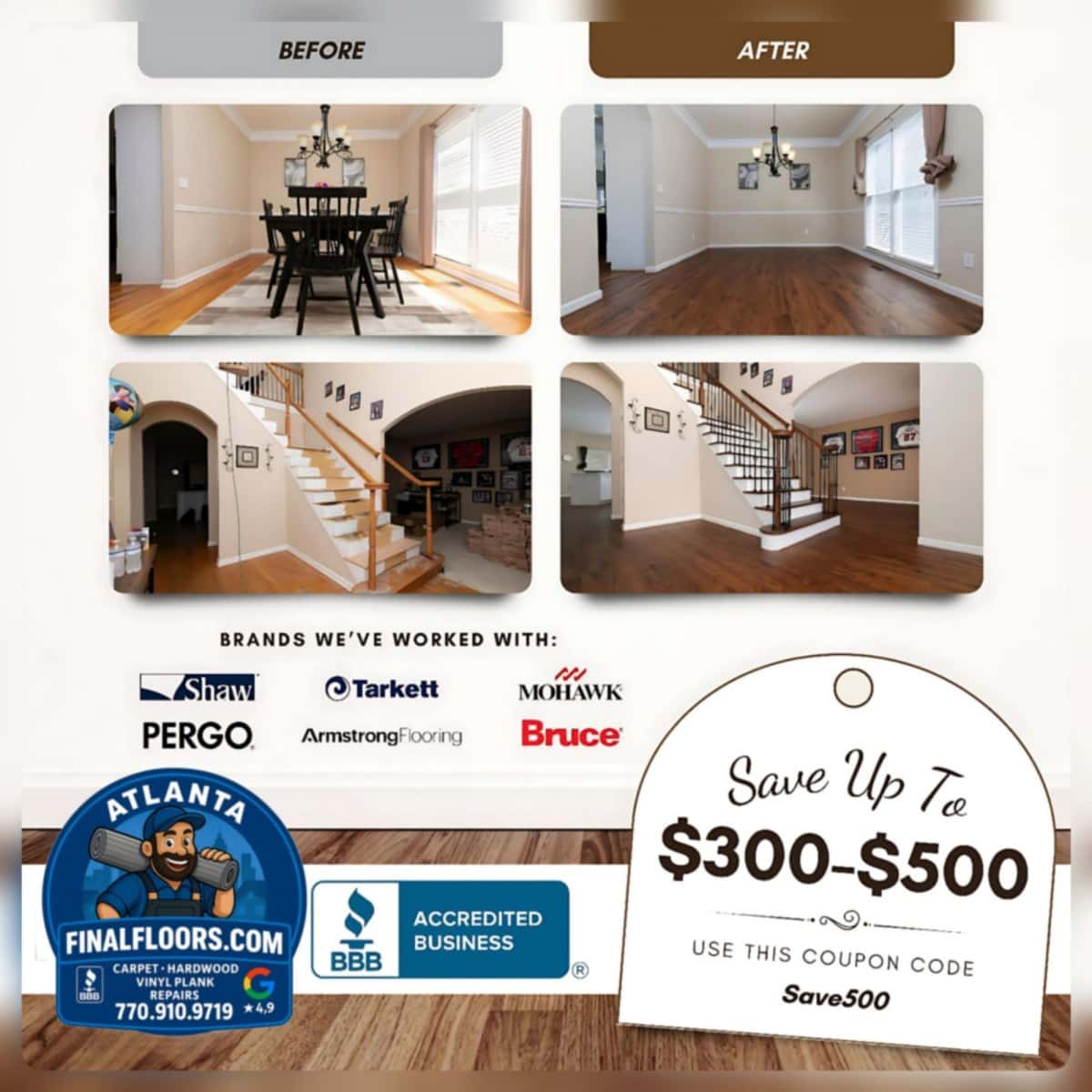
Luxury vinyl plank can be a strong fit for small, high-use spaces because it combines a wood-look surface with relatively easy maintenance and product options designed for moisture-prone rooms. But the **best result depends less on the word “waterproof” on the box and more on choosing the right product, preparing the subfloor correctly, and planning the transitions around the room.
For Metro Atlanta homeowners, landlords and property managers, that matters in kitchens, mudrooms, laundry rooms, finished basements, entryways, rentals and other spaces that see constant traffic.
If you want the short version first, visit **Guess What? Luxury Vinyl Plank Facts**. If you are already comparing installation options, see **Luxury Vinyl Plank Flooring Atlanta**.
Small spaces often take more abuse per square foot than larger rooms. An entryway collects grit and moisture. A laundry room sees vibration, spills and tight appliance clearances. A rental kitchen may be cleaned frequently between occupants. A finished basement can have different moisture conditions than an upper floor.
LVP is popular in these situations because many products offer:
• a durable wear surface for everyday foot traffic;
• wood-look visuals without the maintenance routine of site-finished hardwood;
• rigid-core options that can feel stable underfoot when the substrate is prepared correctly;
• product lines intended for kitchens, laundry areas and other moisture-prone interior spaces;
• a wide range of plank sizes, colors and textures that can make compact rooms feel more continuous.
Those benefits are not automatic. Product specifications, the condition of the subfloor and the installation method still control the outcome.
A better flooring decision starts by asking how the room is actually used.
For a **mudroom or entry**, focus on abrasion resistance, easy cleaning and transitions to adjacent floors. For a **kitchen**, consider chair movement, appliance clearances, sunlight and the possibility of spills. For a **finished basement**, substrate flatness and moisture evaluation become especially important. For a **rental**, the priorities may include repeatable maintenance, replacement availability and a visual that works with many paint and cabinet colors.
This is why two homes can both “need LVP” but still require different products and preparation plans.
Homeowners are often handed a list of numbers without much context. Three specifications deserve particular attention.
The wear layer is the protective surface above the printed design layer. A thicker or more robust wear layer can be useful in higher-traffic applications, but it should not be judged in isolation. Finish chemistry, manufacturer testing, maintenance requirements and the type of traffic in the room also matter.
Rigid-core LVP commonly uses SPC or WPC-style constructions. SPC tends to feel firmer and can be useful where dimensional stability is a priority. WPC products may offer a different feel underfoot. Neither label by itself tells you whether a specific product is right for a specific slab, basement, rental or kitchen.
For a more detailed comparison, see **SPC Flooring Atlanta** and **WPC Flooring Atlanta**.
In a small room, finish can change the way the entire space reads. Extremely glossy surfaces may show dust or scratches more readily, while very busy grain patterns can make a compact room feel visually crowded. A balanced texture and consistent plank variation often create a calmer, more continuous look.
A premium plank installed over a poorly prepared substrate can still fail to look or perform like a premium floor.
Before installation, the floor should be evaluated for the conditions required by the flooring manufacturer. Depending on the project, that can include checking:
• flatness and localized high or low areas;
• loose or damaged substrate sections;
• moisture conditions appropriate to the product and installation method;
• old adhesive, debris or contaminants;
• transitions at doors and adjacent flooring;
• stair noses, cabinets, appliances and other fixed-height details.
If the floor has dips, movement or damaged sections, start with **Floor Leveling & Subfloor Repair Atlanta** rather than trying to make the finish floor hide the problem.
Many LVP products are sold as waterproof or highly water resistant, but that does **not** mean the entire flooring assembly is immune to every water event.
Water can still move around edges, under baseboards, through transitions or beneath a floating floor. A leak can also affect the subfloor or surrounding building materials even when the plank itself is not damaged.
After a significant leak, qualified mitigation, drying or remediation should be completed before flooring putback begins. Final Floors handles the flooring reconstruction/putback phase after that work is complete. See **Water-Damage Flooring Repair Atlanta** and **Guess What? Water-Damage Putback Facts** for the flooring-specific side of that process.
Transitions are easy to overlook because they are usually a small part of the material order, yet they can determine whether a project feels finished.
In a compact space, pay attention to:
• the direction the planks run;
• how the new floor meets hardwood, tile or carpet;
• door clearances;
• appliance height and movement;
• baseboard or shoe molding details;
• thresholds and exterior-door conditions.
The goal is not simply to cover the floor. It is to make the new surface look intentional in relation to the rest of the home.
It can help visually, especially when the flooring creates continuity between connected areas. Wider planks, restrained color variation and a consistent installation direction can reduce visual interruption. Extending one compatible floor through a kitchen, hallway and nearby living area can also make the layout feel more unified.
That said, flooring is only one part of the effect. Lighting, wall color, furniture scale and the number of transitions also influence how spacious a room feels.
For rental housing, the best flooring choice is usually the one that balances appearance, serviceability and realistic maintenance—not simply the lowest material price.
Before selecting a product, property owners should consider whether replacement cartons will be available later, whether the manufacturer allows the intended installation method, how the surface handles the expected traffic, and whether the substrate will need recurring repair between occupants.
For larger portfolios or occupied business spaces, see **Commercial Flooring Atlanta** for planning around traffic, phased work and material selection.
LVP is not automatically the right answer everywhere. Existing hardwood in good structural condition may be worth preserving and refinishing. In living rooms, dining rooms and other areas where the character of real wood matters, hardwood can offer a different visual and long-term ownership experience.
If you are deciding between keeping existing wood and changing materials, compare **Hardwood Floor Refinishing Atlanta** with the LVP options rather than assuming replacement is necessary.
Before ordering material, answer these questions:
• What is the room used for every day?
• Is the substrate flat, stable and appropriate for the planned installation?
• Has moisture been evaluated where conditions call for it?
• What does the product manufacturer require for installation and maintenance?
• How will the new floor transition to adjacent rooms?
• Are stairs, appliances, cabinets or exterior doors part of the scope?
• Do you want the floor to match another area now or leave room for a future phase?
These questions usually reveal more than comparing two product labels side by side.
Product samples are useful, but completed work helps you judge details such as plank direction, transitions, stair coordination and how different colors behave in real rooms. Browse **Final Floors Projects** and the **Flooring Gallery** for examples across Metro Atlanta.
When you are ready for a project-specific recommendation, use the **free flooring estimator** or contact Final Floors with the room type, city, approximate project size and a few photos. The more context we have up front, the faster we can narrow the right options for the space.
It can be. Many LVP products are designed for high-use interior spaces and are easier to maintain than some natural materials. Product selection, subfloor preparation, appliance clearances and the manufacturer's installation requirements still matter.
No. Overall thickness is only one specification. Wear layer, core construction, locking system, finish, substrate conditions and installation requirements should be evaluated together.
The substrate still needs to meet the flooring manufacturer's flatness and preparation requirements. Installing over significant dips, humps or movement can create visible and mechanical problems later. Floor leveling or subfloor repair may be needed first.
Some products are marketed as waterproof, but that does not make the entire room or subfloor waterproof. Water can travel beneath flooring and affect surrounding materials. After a significant water event, the underlying conditions should be evaluated before flooring is reinstalled.
There is no universal best color. Mid-tone and lighter wood looks with controlled variation often create an open, continuous feel, but lighting, cabinetry, wall color and adjoining floors should guide the final choice.
These sourced review excerpts are selected for relevance to LVP / vinyl plank across Metro Atlanta when matching evidence exists. Original service labels and source platforms are preserved; company-level feedback is not relabeled as a local project.
Public reputation footprint: 215+ review records across sources in the governed snapshot dated 2026-09-22. This is not a unique-customer count.
Explore the Final Floors Review Authority Hub · Google Business Profile · BBB profile · Yelp profile · Angi profile
Use this Metro Atlanta flooring guidance to understand the decision, then confirm the recommendation against the actual property and written scope. Final Floors uses route-specific service information, verified project evidence and current Metro Atlanta coverage to guide the next step.
Start with: what you have now · what you want next · the property city or ZIP · desired timing.
Final Floors routes commercial, water-damage, LVP/LVT and whole-home flooring searches to the strongest canonical service owner available for the market rather than creating duplicate landing pages.
First-party project proof: Commercial project proof · Water-loss flooring project proof · LVP project proof · Whole-home flooring project proof
Call 770-910-9719 or text 770-870-9876 for a project-specific estimate.