What decision does this article help with?
Hardwood Installation Atlanta Precision Acclimation Buckling — flooring insights from Final Floors LLC, serving Metro Atlanta since 2016. 4.9★ Google · BBB
Hardwood Installation Atlanta Precision Acclimation Buckling — flooring insights from Final Floors LLC, serving Metro Atlanta since 2016. 4.9★ Google · BBB Use the related Final Floors service, city and project links on this page if the topic matches a real Metro Atlanta flooring project. Call 770-910-9719 for a project-specific estimate.
Start Project Match · View Final Floors projects · Call 770-910-9719
Hardwood Installation Atlanta Precision Acclimation Buckling — flooring insights from Final Floors LLC, serving Metro Atlanta since 2016. 4.9★ Google · BBB
Hardwood Flooring Installation is the canonical Final Floors service resource for the transactional side of this topic. The article is supporting education and does not replace the property-specific written scope or estimate.
Use Project Match to send the project city, flooring type, approximate scope and known site conditions directly to Final Floors LLC. A written estimate controls the actual scope, recommendation and price.
Start Project Match · View real Final Floors projects · Call 770-910-9719
Final Floors LLC · Metro Atlanta Flooring Education
Why 72 hours is a myth: Metro Atlanta acclimation timelines, psychrometric data, EMC testing, and pro moisture-testing methods for flawless hardwood installation Atlanta.
Published 2026-07-23 · Updated 2026-09-23
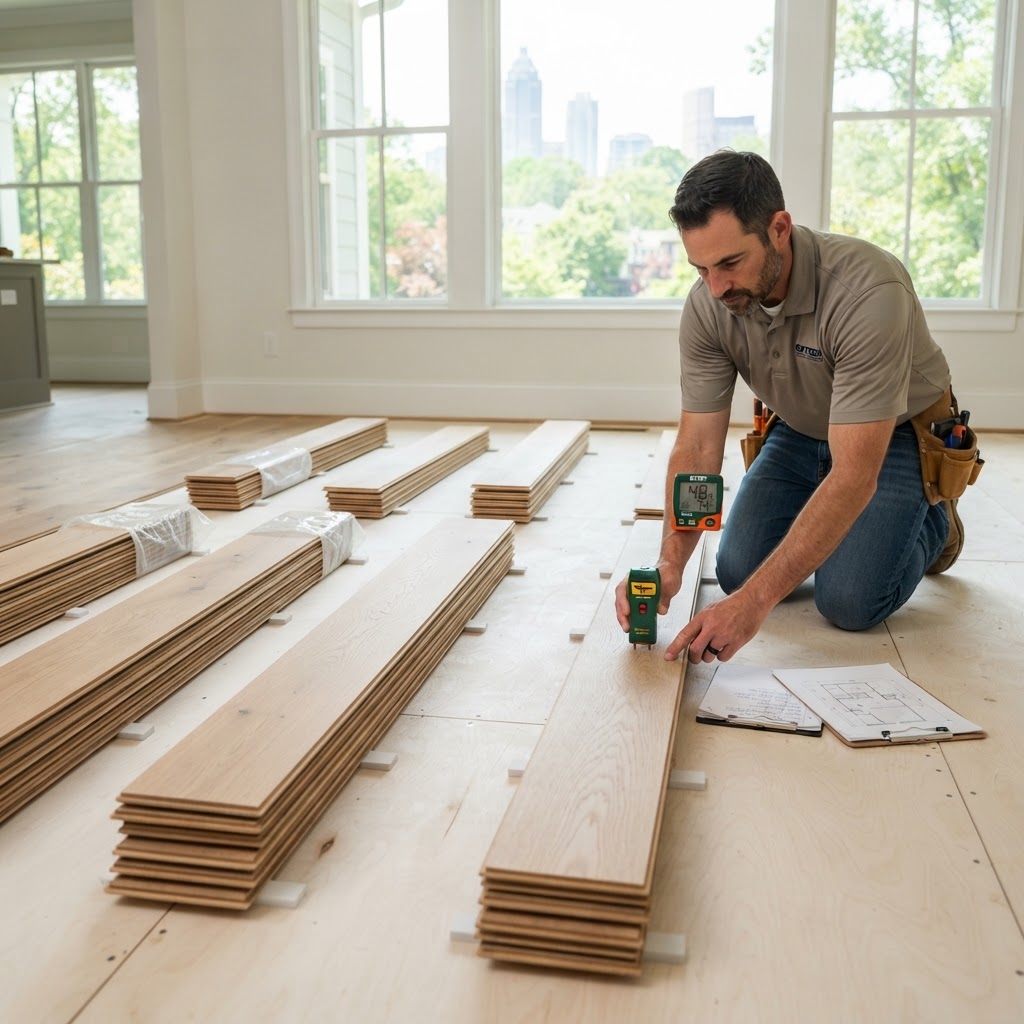
How long does hardwood need to acclimate in Atlanta before it can be installed? It isn't a single number — it should acclimate until the flooring's moisture content reaches the jobsite's Equilibrium Moisture Content (EMC). In Metro Atlanta that typically means engineered hardwood will often stabilize in 3–7 days if HVAC is controlled, while solid hardwood commonly requires 7–21 days. At Final Floors we never rely on a calendar; we confirm EMC with moisture meters and ASTM-based concrete RH tests before any hardwood installation Atlanta proceeds.
As the Managing Partner with 20+ years of hands-on flooring experience (Final Floors LLC — 4.9★ Google, BBB A+, verified customer reviews), I’ve overseen more than 2,500 hardwood installations across Atlanta neighborhoods (Buckhead 30305, Midtown 30308, Virginia-Highland 30306, Inman Park 30307, Sandy Springs 30328), Cumming (30040) and Suwanee (30024). Below I explain the local science, seasonal psychrometric data, field-testing protocol, and pricing you can expect in 2026 so you and your contractor avoid buckling wood floors and failed installs.
The ‘72 hours’ acclimation guideline is an oversimplified rule-of-thumb carried over from manufacturers’ historical guidance. It ignores two things that matter most in Metro Atlanta: (1) seasonal relative humidity swings and (2) the need to reach EMC, not just 'sit the boxes in the house.'
• Atlanta has strong seasonal humidity changes — summer dew points and airborne moisture are far higher than winter.
• Hardwood reacts to ambient relative humidity (RH) and temperature — not elapsed time alone.
So for hardwood installation Atlanta, we treat acclimation as a measurement process: measure, equalize, verify. When the wood’s moisture content equals the jobsite EMC within the acceptable tolerance, we install.
• EMC (Equilibrium Moisture Content): The moisture content wood will hold at a given temperature and relative humidity.
• MC (Moisture Content): Percent moisture in the wood measured with a moisture meter.
• RH (Relative Humidity): Percent of moisture present in air compared with the amount it can hold at that temperature.
• ASTM F2170: Industry standard test method for in-situ RH of concrete slabs using probes.
• Pin & Non-invasive Meters: Tools to measure wood MC; pin meters read electrical resistance between pins, non-invasive meters use sensors.
We collect long-term local climate data and combine it with field results from thousands of Atlanta installs. Below is a practical monthly relative-humidity guide we use for hardwood installation Atlanta. This is aggregated historical data (averages) from metro weather datasets and our in-field EMC observations across neighborhoods and ZIPs listed above.
| Month | Typical Avg Outdoor RH (%) | Typical In-Home RH (with HVAC) | Practical Acclimation Guidance (solid / engineered) | |---|---:|---:|---:| | January | 66% | 35–45% | Solid 10–14 days; Engineered 3–7 days | | February | 64% | 35–45% | Solid 10–14 days; Engineered 3–7 days | | March | 61% | 35–45% | Solid 7–14 days; Engineered 3–7 days | | April | 61% | 40–50% | Solid 7–14 days; Engineered 3–7 days | | May | 67% | 40–55% | Solid 10–21 days; Engineered 5–10 days | | June | 73% | 45–60% | Solid 14–21+ days; Engineered 7–14 days | | July | 74% | 45–60% | Solid 14–21+ days; Engineered 7–14 days | | August | 74% | 45–60% | Solid 14–21+ days; Engineered 7–14 days | | September | 72% | 40–55% | Solid 10–21 days; Engineered 5–10 days | | October | 69% | 40–50% | Solid 7–14 days; Engineered 3–7 days | | November | 69% | 35–45% | Solid 7–14 days; Engineered 3–7 days | | December | 67% | 35–45% | Solid 10–14 days; Engineered 3–7 days |
Notes: In-home RH values assume active HVAC with typical thermostat setpoints (68–75°F). Absolute days are estimates; Final Floors confirms EMC before installation.
Hardwood is hygroscopic — it gains or loses moisture to match the surrounding air until it reaches EMC. If you install boards that are too wet relative to your home’s EMC, they will dry and shrink after install, creating gaps. If boards are too dry and you install in low-RH conditions, they will swell later when humidity rises and may buckle.
For hardwood installation Atlanta we use this practical rule-of-thumb from decades of installations and industry guidance:
• Solid hardwood: acceptable moisture content difference between wood and wood subfloor is typically ≤2 percentage points (MC), with floorwood MC commonly settling in the 6–12% band depending on season. Solid plank width increases sensitivity — wide-plank (5"+) reacts more dramatically and requires tighter control.
• Engineered hardwood: more dimensionally stable than solid, commonly allowed tolerance is ≤3 percentage points (MC) between floor and subfloor, and engineered often acclimates faster.
EMC is a function of indoor RH and temperature — so controlling HVAC during acclimation speeds equilibrium and reduces risk.
Here’s our step-by-step moisture-testing and acclimation workflow we follow for every hardwood installation Atlanta job:
• Pre-visit: We advise homeowners how to set HVAC (68–72°F, normal occupied humidity) 48–72 hours before delivery.
• Delivery staging: We open boxes and spread bundles to allow air movement; we do not stack boxes tightly on concrete slabs.
• Initial wood MC reading: We take pin and non-invasive readings from random boards (5–10 locations) using Delmhorst/Wagner meters.
• Subfloor and slab testing:
• Wood subfloors: pin meter readings across joists/subfloor.
• Concrete slabs: ASTM F2170 in-situ RH probe testing and/or calcium chloride tests where requested; surface moisture and depth RH both documented.
• Compare readings: We compare wood MC to subfloor MC or slab RH and compute EMC target.
• Controlled acclimation: If readings exceed tolerance, we run dehumidifiers or humidifiers to bring ambient RH to target and repeat testing until MC/EMC tolerance is met.
• Final sign-off: We record a moisture report with all readings, time-stamped and attached to the job file before installing.
We commonly accept installation when:
• Wood MC is within 2% of wood subfloor MC for solid hardwood, or within 3% for engineered over wood.
• For concrete, we follow manufacturer limits using ASTM F2170 RH: many hardwoods accept slab RH ≤75% with proper moisture mitigation; we prefer RH <65% for solid hardwood unless manufacturer has specific protocols.
• Moisture meters: Delmhorst (pin meters), Wagner Orion (non-invasive), Tramex Concrete Moisture Encounter; Protimeter for verification.
• Concrete RH testing: ASTM F2170 in-situ probes.
• Dehumidification: desiccant and refrigerant dehumidifiers for mitigation.
• Industry standards: NWFA installation guidelines, ASTM F2170, and manufacturer installation manuals (Shaw, Mohawk, Mannington, COREtec guidance where relevant).
• Wide-plank solid hardwood (5"+): Greater dimensional movement; needs the tightest acclimation discipline. In Atlanta summer, expect more swelling—plan for larger expansion gaps and longer acclimation (often 14–21 days).
• Narrow solid strip (2.25"–3.25"): Still hygroscopic but less movement — typical acclimation 7–14 days depending on season.
• Engineered hardwood: Cross-laminated layers reduce movement. Engineered often reaches EMC faster (3–10 days) but should still be tested. For floating engineered installations, check manufacturer RH limits for adhesives and underlayment.
Concrete retains moisture. When homeowners place delivered hardwood on a slab or when ground moisture migrates into a slab, the slab can maintain a higher in-situ RH than indoor air. That mismatch drives moisture into the wood after installation and can produce buckling.
Final Floors uses ASTM F2170 RH probes at 40% of slab depth to validate slab conditions. If RH is high, we install vapor mitigation (epoxy surface treatments, surface primers) or hold installation until slab drying and dehumidification succeed.
Below are current 2026 typical price ranges we see across Atlanta, Cumming, and Suwanee for turnkey hardwood installation Atlanta. Prices vary by material, plank width, site conditions, and moisture-mitigation needs.
| Service / Material | Typical 2026 Metro Atlanta Cost (material + install) | Notes | |---|---:|---| | Engineered hardwood (mid-grade, 5" plank) | $9.50 – $14.50 / sq ft | Includes perimeter trim; floating or glue-down options vary | | Solid hardwood (3" strip, red oak) | $11.50 – $16.50 / sq ft | Nail-down on wood subfloor typical; wider planks cost more | | Wide-plank solid (5"+) | $14.50 – $22.00 / sq ft | Requires extra acclimation, more labor for layout | | Luxury vinyl plank (COREtec, Karndean alternative) | $6.50 – $12.50 / sq ft | For high-moisture areas or basements | | Moisture testing (ASTM F2170 RH slab report) | $150 – $350 | Per test (multiple probes may be required) | | Moisture mitigation (epoxy vapor barrier on slab) | $2.50 – $5.50 / sq ft | Varies with prep and warranty | | Subfloor leveling / floor leveling repair | $3.00 – $8.00 / sq ft | Depends on depth of leveling and local conditions |
Pricing example: 1,200 sq ft engineered install in Midtown (30308) with typical subfloor and no mitigation — expect $11,400–$17,400 total. Add $400 for ASTM F2170 testing and $1,800–$4,200 for mitigation if RH is high.
If hardwood buckles after installation, the repair path can be expensive: remove, dry, possibly replace boards, repair subfloor, re-install. Typical buckling wood floors repair in Atlanta ranges from $6–$20 per sq ft depending on scope. Insurance claims may apply when moisture source is covered (water damage from burst pipe, roof leak). We routinely work with homeowners who file claims with State Farm, Allstate, USAA and provide detailed moisture reports to support their claims.
Prevention steps we take on every hardwood installation Atlanta job to avoid buckling:
• Full moisture report attached to contract
• ASTM F2170 RH testing on concrete slabs
• Controlled HVAC during acclimation and installation
• Proper expansion gaps per species and plank width
• Approved adhesives and vapor retarders where required
Leaving the right expansion gap around perimeters, columns and at transitions is one of the most under-appreciated steps to avoid buckling.
Typical guidance we use (final gap depends on species and width):
• Solid hardwood narrow strip: 3/8" – 1/2" per perimeter
• Wide plank solid (5"+): 1/2" – 3/4" perimeter
• Engineered floating: follow manufacturer, commonly 1/4" – 1/2"
We document gap details on every contract and use spacers during install. If a homeowner later narrows or conceals gaps improperly (with tight trim), that can reintroduce buckling risk.
• Buckhead townhome (30305): 1,100 sq ft wide-plank solid oak delivered in July. Boxes placed on a slab garage during staging; HVAC not active. Result: boards absorbed moisture and cupped during install. Fix: Remove, recondition in controlled environment, re-install with larger expansion gaps and surface-sanded. Lesson: never stage boxes on a damp slab; always test.
• Suwanee renovation (30024): Engineered install over concrete slab in May. ASTM F2170 RH = 78% at depth. We applied a two-coat epoxy vapor barrier and ran dehumidifiers for 3 weeks. Install passed final RH checks and warranty approved by manufacturer. Lesson: slab RH must be measured — surface dryness is deceptive.
• Engineered choices: Shaw, Mohawk, Mannington (solid brand lines for stability and local warranties).
• Luxury options: COREtec (for moisture-prone rooms where wood-look LVP is preferred), Karndean for vinyl-based alternatives.
• Adhesives and underlayments: Use manufacturer-approved adhesives for glue-downs; certain adhesives require RH below specific limits.
We select products based
These sourced review excerpts are selected for relevance to hardwood flooring across Metro Atlanta when matching evidence exists. Original service labels and source platforms are preserved; company-level feedback is not relabeled as a local project.
Public reputation footprint: 215+ review records across sources in the governed snapshot dated 2026-09-22. This is not a unique-customer count.
Explore the Final Floors Review Authority Hub · Google Business Profile · BBB profile · Yelp profile · Angi profile
Use this Metro Atlanta flooring guidance to understand the decision, then confirm the recommendation against the actual property and written scope. Final Floors uses route-specific service information, verified project evidence and current Metro Atlanta coverage to guide the next step.
Start with: what you have now · what you want next · the property city or ZIP · desired timing.
Final Floors routes commercial, water-damage, LVP/LVT and whole-home flooring searches to the strongest canonical service owner available for the market rather than creating duplicate landing pages.
First-party project proof: Commercial project proof · Water-loss flooring project proof · LVP project proof · Whole-home flooring project proof
Call 770-910-9719 or text 770-870-9876 for a project-specific estimate.