What decision does this article help with?
After Water Damage: Plan Flooring Reinstallation. Plan flooring after mitigation, drying and required clearance.
Loading your flooring page…
Helpful guides for your flooring decision
Plan flooring repair or replacement after source control and required mitigation, drying and remediation are complete.
Understand substrate condition, product requirements and the preparation included in your estimate.
More from Flooring Insights
Plan flooring repairs after mitigation, drying and needed remediation are completed by others.
After Water Damage: Plan Flooring Reinstallation. Plan flooring after mitigation, drying and required clearance. Use the related Final Floors service, city and project links on this page if the topic matches a real Metro Atlanta flooring project. Call 770-910-9719 for a project-specific estimate.
Start Project Match · View Final Floors projects · Call 770-910-9719
After Water Damage: Plan Flooring Reinstallation. Plan flooring after mitigation, drying and required clearance.
Visit Post-Mitigation Water-Damage Flooring for the related flooring service and project-planning details. This article provides general guidance; the written scope and estimate are specific to your property.
Use Project Match to send the project city, flooring type, approximate scope and known site conditions directly to Final Floors, LLC. A written estimate controls the actual scope, recommendation and price.
Start Project Match · View real Final Floors projects · Call 770-910-9719
Final Floors LLC · Metro Atlanta Flooring Education
Flooring education from Final Floors LLC
Plan flooring reinstallation after water damage in Metro Atlanta, including readiness, subfloor repair, product matching, documentation and replacement choices.
Published 2026-05-22 · Updated 2026-08-14
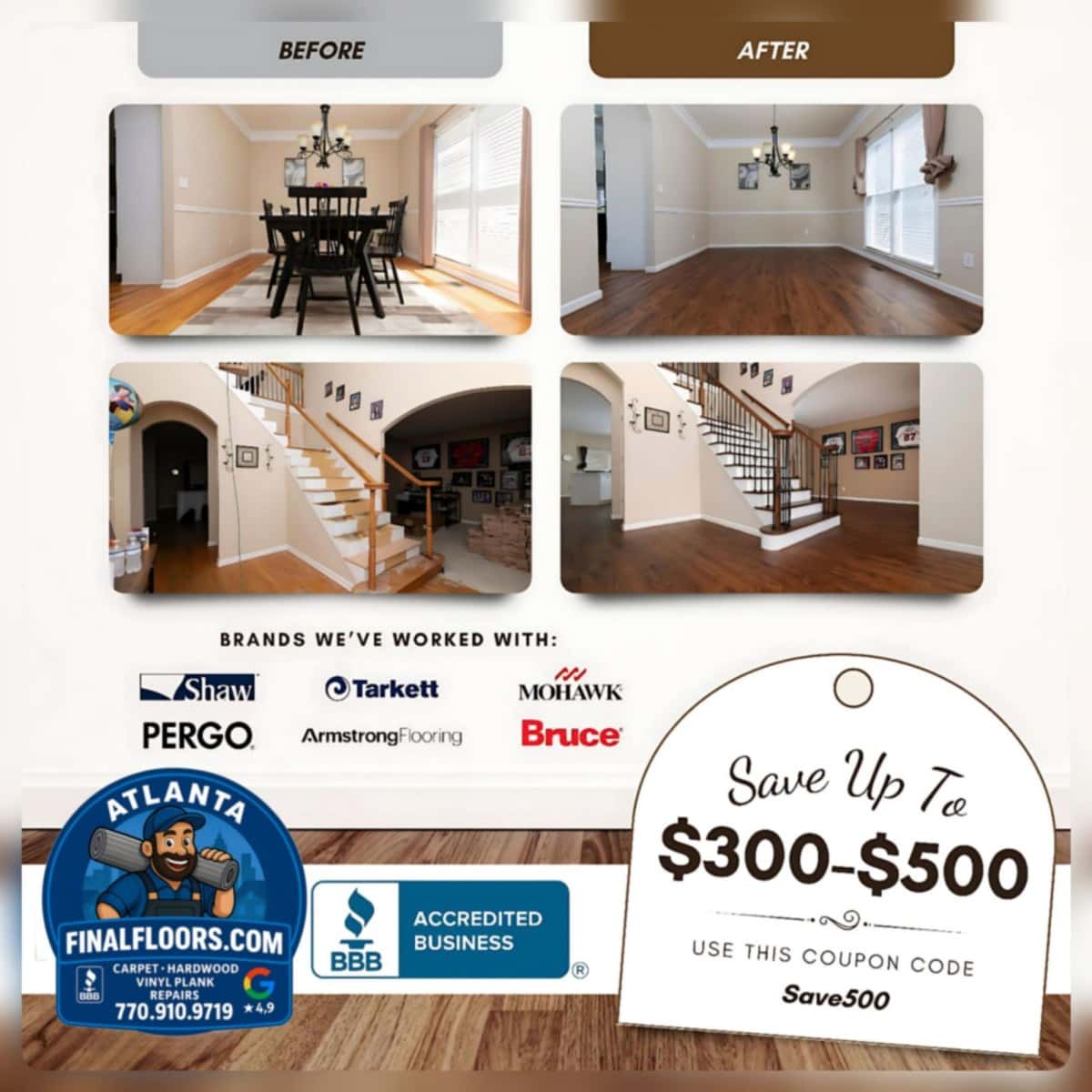
After a water loss, flooring work should begin only after the required mitigation, drying and remediation are complete. The flooring scope then depends on the affected material, substrate condition, moisture findings, floor preparation and the replacement or repair system selected for the property.
Flooring reconstruction should begin after the water source has been stopped and the required mitigation, drying and remediation work is complete.** A room can look dry on the surface and still need additional evaluation before new flooring goes back in.
Final Floors focuses on the **flooring putback and reconstruction phase**: evaluating the affected flooring, handling flooring-related subfloor repair and preparation, comparing replacement options, and installing the finished floor once the property is ready.
For quick answers, visit **Guess What? Water Damage Putback Facts**. For service details, see **Water-Damage Flooring Repair Atlanta**.
Water extraction, structural drying, mold remediation and environmental cleanup belong with qualified mitigation or environmental providers when those services are required.
Flooring putback begins later. The flooring contractor’s job is to understand what was removed or damaged, confirm the flooring area is ready for reconstruction, prepare the substrate, help select replacement materials and rebuild the finished floor.
Keeping those scopes clear prevents a flooring page from promising services it does not actually perform.
Before flooring is reinstalled, the project may need answers to questions such as:
• Has the source of water been corrected?
• Has the required mitigation or remediation phase been completed?
• What flooring and underlayment were removed?
• Is the exposed substrate stable and suitable for the replacement system?
• Are there damaged panels, soft areas or transition issues that need flooring-related repair?
• Does the selected flooring require moisture evaluation, a barrier or another preparation step?
The correct answer depends on the building and flooring product. A universal “wait this many days” rule is not reliable.
Insurance-related projects often involve several parties: the property owner, mitigation provider, flooring contractor, adjuster and sometimes a property manager or association.
Useful flooring documentation may include:
• room measurements;
• photos of flooring and exposed substrate conditions;
• product or material information;
• notes on matching limitations;
• a written flooring scope;
• estimates and flooring-specific line-item detail where appropriate.
Final Floors can provide flooring documentation and estimates for the reconstruction scope. **Coverage, matching obligations, approvals and payment decisions remain with the policyholder, insurer and adjuster.
After a partial loss, homeowners often want the replacement area to disappear into the surviving floor. Sometimes a close match is practical. Sometimes it is not.
Factors include:
• wood species or product construction;
• plank width and length;
• texture and edge profile;
• stain and finish;
• dye lot or manufacturing variation;
• age and wear of the existing floor;
• current product availability;
• transitions between affected and unaffected areas.
The right recommendation may be a localized repair, a planned transition or a broader replacement. That decision should follow the actual materials and conditions rather than a promise made before inspection.
A water event can be a reason to reconsider the flooring system rather than automatically reinstalling the same material.
Hardwood** may still be the right choice when the space, substrate and homeowner priorities support it.
Engineered hardwood** can provide real-wood appearance with a layered construction that may suit some installation environments better than solid wood.
Rigid-core LVP** may be attractive in kitchens, rentals, lower levels or other spaces where easy maintenance and moisture-resistant plank construction are priorities.
Carpet** can remain a practical option for bedrooms, upstairs areas and spaces where comfort or sound absorption matters.
None of these choices eliminates the need to correct the source of the water event and prepare the substrate properly.
For product comparisons, explore **LVP facts**, **hardwood facts** and **carpet facts**.
Once damaged flooring is removed, the exposed substrate may reveal localized swelling, softness, delamination, movement or other conditions that were not visible before.
Flooring-related subfloor work may include targeted panel replacement, fastening correction, patching or preparation. Conditions that appear structural, environmental or outside ordinary flooring scope should be handled by the appropriate qualified professional before the finish floor is installed.
See **Subfloor Repair & Floor Leveling Atlanta** for more detail.
Water damage does not always stop neatly at a doorway. A flooring reconstruction can involve hallways, stairs, closets, kitchens or adjoining rooms with different materials.
Planning should address:
• finished floor heights;
• stair nosing and landings;
• doorway transitions;
• baseboards or shoe molding;
• partial-repair boundaries;
• visual continuity between surviving and replacement flooring.
Those details can affect both material quantity and whether a partial repair will look intentional.
• Is mitigation and required drying/remediation complete?
• What flooring-related substrate repairs are needed?
• Can the existing material be matched realistically?
• What replacement systems fit the room and substrate?
• What documentation is needed for the flooring scope?
• How will transitions, stairs and adjacent rooms be handled?
• What manufacturer requirements apply to the selected product?
A clear reconstruction plan is more valuable than rushing directly to material selection.
Next steps:** explore **Water-Damage Flooring Repair Atlanta**, browse **project examples**, review **customer feedback**, or request a **free project estimate**.
Flooring work should begin only after the required mitigation, drying and remediation are complete. Installing over a substrate that has not been assessed or dried can trap moisture beneath the new floor. Confirm the affected materials, moisture findings and floor preparation before scheduling installation.
No. A waterproof plank is a flooring product characteristic, not protection for the structure. It does not stop leaks, flooding or moisture movement through a slab, and it does not make a room watertight. Address the water source and any required remediation before choosing the floor covering.
Collect the drying logs, moisture readings, affected areas and any removal records from the mitigation company, along with the insurer's scope if a claim is involved. These documents let the flooring scope be written against verified site conditions rather than assumptions.
The affected material, substrate condition, moisture findings, floor preparation needs, adjoining floors and trim or transition details all shape the scope. Matching limitations between existing and replacement material are also reviewed. The written estimate should list preparation and exclusions separately.
Call 770-910-9719 or use the online estimator with the property city or ZIP, the rooms involved and the current floor covering. Final Floors LLC reviews the details and confirms next steps for that property.
These sourced review excerpts are selected for relevance to water-damage flooring across Metro Atlanta when matching evidence exists. Original service labels and source platforms are preserved; company-level feedback is not relabeled as a local project.
Customer review records: 236+ review records across sources as of 2026-11-13. This is not a unique-customer count.
Explore Final Floors customer reviews · Google Business Profile · BBB profile · Yelp profile · Angi profile
Use this Metro Atlanta flooring guidance to understand the decision, then confirm the recommendation against the actual property and written scope. Tell us about your existing floor, the result you want and any known preparation needs so we can help you plan the next step.
Start with: what you have now · what you want next · the property city or ZIP · desired timing.
Compare commercial flooring, post-mitigation repairs, LVP/LVT and whole-home options. Review the relevant service, then tell us your city and project details for an estimate.
Final Floors project examples: Commercial project proof · Water-loss flooring project proof · LVP project proof · Whole-home flooring project proof
Call 770-910-9719 or text 770-870-9876 for a project-specific estimate.