What decision does this article help with?
Water-Damage Flooring: Handoff and Repair Decisions. Plan flooring after mitigation, drying and required clearance.
Loading your flooring page…
Helpful guides for your flooring decision
Plan flooring repair or replacement after source control and required mitigation, drying and remediation are complete.
Understand substrate condition, product requirements and the preparation included in your estimate.
Water-Damage Flooring: Handoff and Repair Decisions. Plan flooring after mitigation, drying and required clearance. Use the related Final Floors service, city and project links on this page if the topic matches a real Metro Atlanta flooring project. Call 770-910-9719 for a project-specific estimate.
Start Project Match · View Final Floors projects · Call 770-910-9719
Water-Damage Flooring: Handoff and Repair Decisions. Plan flooring after mitigation, drying and required clearance.
Visit Post-Mitigation Water-Damage Flooring for the related flooring service and project-planning details. This article provides general guidance; the written scope and estimate are specific to your property.
Use Project Match to send the project city, flooring type, approximate scope and known site conditions directly to Final Floors, LLC. A written estimate controls the actual scope, recommendation and price.
Start Project Match · View real Final Floors projects · Call 770-910-9719
Final Floors LLC · Metro Atlanta Flooring Education
Flooring education from Final Floors LLC
Plan the flooring stage after a water loss with a clear handoff from mitigation. Learn what records to gather, how coverage decisions differ from flooring recommendations, and what affects repair, matching, replacement and return-to-use planning.
Published 2026-03-16 · Updated 2026-11-12
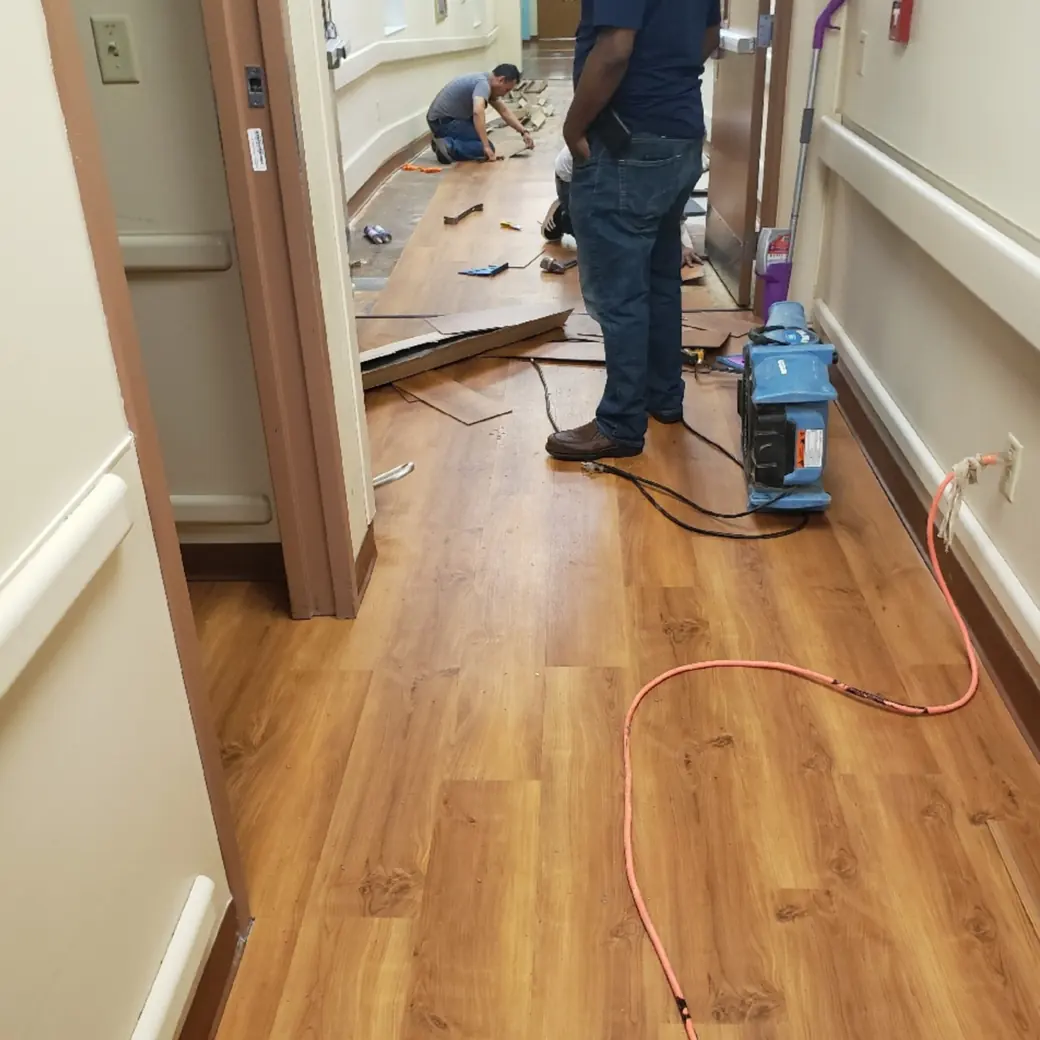
After a water loss, flooring work should begin only after the required mitigation, drying and remediation are complete. The flooring scope then depends on the affected material, substrate condition, moisture findings, floor preparation and the replacement or repair system selected for the property.
After a water loss, flooring decisions are easier when everyone understands what has been completed, what remains unresolved and who is responsible for the next step. The visible floor is only part of that conversation. The cause of the loss, mitigation work, underlying conditions and replacement options all affect the plan.
This guide focuses on the handoff into flooring repair or replacement for Metro Atlanta homes, rental properties and businesses. Water extraction, structural drying, sewage cleanup, mold remediation and fire restoration are outside our service scope. Final Floors handles flooring putback after mitigation, drying and any required remediation are completed by the appropriate providers.
An area that looks dry is not, by itself, evidence that it is ready for new flooring. Before a flooring project is scheduled, clarify the status of the loss and the work already performed.
Ask the responsible providers about:
• The cause of the water problem and whether it has been addressed.
• The areas affected and any conditions still under evaluation.
• Mitigation, drying and any required remediation completed or outstanding.
• Materials removed and anything left in place for further assessment.
• Access restrictions or additional repairs needed before flooring work.
• Available records that explain the completed work and remaining conditions.
The flooring installer must also evaluate readiness for the selected flooring system. Completion of mitigation and suitability for a particular flooring installation are related decisions, but one record should not be assumed to answer every question.
If there is active water, suspected contamination, unresolved damage or an unsafe area, address that with the appropriate provider before proceeding. A new floor should not conceal an unresolved problem.
Gather the information that helps the owner, mitigation provider, flooring installer and insurer understand the same set of conditions. Keep originals and identify the source of each record.
Useful information may include:
• The date the loss was discovered and the known cause.
• Photos of the affected rooms and any exposed flooring layers.
• Available mitigation or repair reports and records.
• A room list identifying affected areas and adjacent flooring.
• Original flooring invoices, product labels, spare material or packaging.
• The proposed flooring scope and any later approved changes.
• Product information and care instructions for the completed installation.
Ask what the flooring contractor will document as part of the agreed scope. Do not assume every project includes a particular report, testing service or insurance package unless that has been confirmed.
Photos are most useful when the room and subject are clear. Avoid entering unsafe areas or disturbing materials simply to obtain a better image. Share claim documents only with the parties who need them for the work involved.
A flooring proposal explains proposed work. It does not establish that an insurer will pay for every item, approve a particular replacement or cover an upgrade.
If a claim is involved, ask the insurer or adjuster what information is needed and how scope changes should be handled. Keep the covered work, owner-selected upgrades and any unresolved items clear before authorizing the project. Confirm responsibility for costs directly rather than relying on “insurance-ready” or “insurance-related” marketing language.
The owner or authorized project representative should also clarify who communicates changes between the mitigation provider, other repair contractors and the flooring installer. Keep the contact person and responsibility for each stage clear so that questions reach the right provider.
Selective repair may be possible, but it should be based on the condition of the materials and the requirements of the flooring system. Removing only the most visibly damaged area does not always establish a complete repair scope.
The assessment should consider affected boards or panels, the substrate, adjoining flooring and the installation method. Conditions exposed during removal may change the proposed work. Agree in advance how additional findings will be documented and how the owner will approve any change.
Localized board replacement or refinishing may be worth evaluating when the remaining floor is suitable. Sandability depends on the flooring's construction, remaining usable surface, prior work and condition. Sanding cannot repair compromised support or resolve an active moisture problem.
A repair may remain visible because of age, species, grain, color or existing finish. Discuss the likely appearance and any sampling options before assuming a seamless match. Refinishing is a dust-conscious construction process, not a dust-free guarantee.
Identify the existing product and installation method before assuming individual pieces can be replaced. Availability, dimensions, edge or locking details and the surrounding installation can affect the repair approach.
If replacing a larger area, select a product appropriate for the room and substrate. Waterproof flooring does not waterproof the structure or prevent every consequence of a future leak. Follow the exact product's preparation, conditioning and installation requirements.
The condition of the floor covering and the layers beneath it matters. Confirm the appropriate scope after the water-loss conditions have been addressed. Product availability, layout and appearance can affect whether a local repair is practical or whether a larger replacement area should be considered.
Do not assume a new carpet surface alone resolves problems in the cushion or substrate.
Bring any spare pieces, labels, invoices or product details to the flooring discussion. Older colors and product lines may be unavailable, and a new product can look different beside an aged floor even when its description is similar.
Compare potential replacements with adjacent rooms and transitions. Consider whether to retain a visible boundary, replace a continuous area or choose a different material for the affected space. The appropriate choice depends on the actual conditions, available products, owner preferences and any applicable claim decisions.
Avoid treating an upgrade as automatically necessary, covered or protective against future water losses. The cause of the original problem still needs to remain addressed.
A useful schedule begins with readiness and scope, not a fixed number of days. Material lead times, additional repairs, preparation, access and the selected products' requirements can all affect timing.
For an occupied home or business, agree on:
• Work areas and any practical phasing.
• Furniture, appliance and equipment responsibilities.
• Safe access, exits and areas that must remain restricted.
• Protection, debris removal and cleanup included in the scope.
• How newly discovered conditions or delays will be communicated.
• When walking, furniture, rolling loads, rugs and cleaning may resume.
Do not assume evening work, uninterrupted operations or immediate occupancy is available. Confirm the project plan and follow the installed products' return-to-use instructions.
Final Floors LLC has served Metro Atlanta since 2016 with flooring installation, repair and related preparation. To discuss the flooring stage of your project, visit FinalFloors.com, call 770-910-9719 or text 770-870-9876. Include the affected rooms, photos, known mitigation status and target timing so the next steps can be discussed with the right information.
Final Floors LLC provides hardwood installation and refinishing, luxury vinyl plank, laminate, carpet, staircase flooring, subfloor repair and floor leveling, commercial flooring and post-mitigation flooring putback for eligible residential and commercial properties in Metro Atlanta.
Share the property city or ZIP, the current floor covering, the rooms involved, the approximate scope, the conditions you have noticed and your desired timing. Photos help. The actual substrate, the selected product and a written scope control the final recommendation.
Compare what each one includes rather than only the bottom line: removal, disposal, preparation, moisture and flatness work, underlayment, transitions, trim and cleanup. Check whether the same product and the same preparation scope is being quoted on both.
Final Floors LLC is a mobile flooring service for eligible properties across Metro Atlanta and has served the area since 2016. Coverage depends on the specific property and project scope. Share the city or ZIP and the project details to confirm.
Call 770-910-9719 or use the online estimator with the property city or ZIP, the rooms involved and the current floor covering. Final Floors LLC reviews the details and confirms next steps for that property.
These sourced review excerpts are selected for relevance to water-damage flooring across Metro Atlanta when matching evidence exists. Original service labels and source platforms are preserved; company-level feedback is not relabeled as a local project.
Customer review records: 236+ review records across sources as of 2026-11-13. This is not a unique-customer count.
Explore Final Floors customer reviews · Google Business Profile · BBB profile · Yelp profile · Angi profile
Use this Metro Atlanta flooring guidance to understand the decision, then confirm the recommendation against the actual property and written scope. Tell us about your existing floor, the result you want and any known preparation needs so we can help you plan the next step.
Start with: what you have now · what you want next · the property city or ZIP · desired timing.
Compare commercial flooring, post-mitigation repairs, LVP/LVT and whole-home options. Review the relevant service, then tell us your city and project details for an estimate.
Final Floors project examples: Commercial project proof · Water-loss flooring project proof · LVP project proof · Whole-home flooring project proof
Call 770-910-9719 or text 770-870-9876 for a project-specific estimate.