What decision does this article help with?
Commercial Flooring: Products, Maintenance and Access. Review room use, cushion, seams, removal and floor preparation.
Loading your flooring page…
Helpful guides for your flooring decision
Plan furniture pads and everyday care to protect your hardwood finish.
Understand the refinishing process, cost considerations and timing before your estimate.
More from Flooring Insights
Compare floor condition, project access and the selected finish's return-to-use instructions.
Plan use zones, preparation, operating access and product requirements before comparing estimates.
Commercial Flooring: Products, Maintenance and Access. Review room use, cushion, seams, removal and floor preparation. Use the related Final Floors service, city and project links on this page if the topic matches a real Metro Atlanta flooring project. Call 770-910-9719 for a project-specific estimate.
Start Project Match · View Final Floors projects · Call 770-910-9719
Commercial Flooring: Products, Maintenance and Access. Review room use, cushion, seams, removal and floor preparation.
Visit Carpet Installation for the related flooring service and project-planning details. This article provides general guidance; the written scope and estimate are specific to your property.
Use Project Match to send the project city, flooring type, approximate scope and known site conditions directly to Final Floors, LLC. A written estimate controls the actual scope, recommendation and price.
Start Project Match · View real Final Floors projects · Call 770-910-9719
Final Floors LLC · Metro Atlanta Flooring Education
Flooring education from Final Floors LLC
Evaluate LVP, carpet tile, engineered hardwood and laminate against the same commercial requirements. Compare intended use, repairs, acoustics, full costs and access without assuming a universal ranking or reopening schedule.
Published 2026-02-20 · Updated 2026-11-12
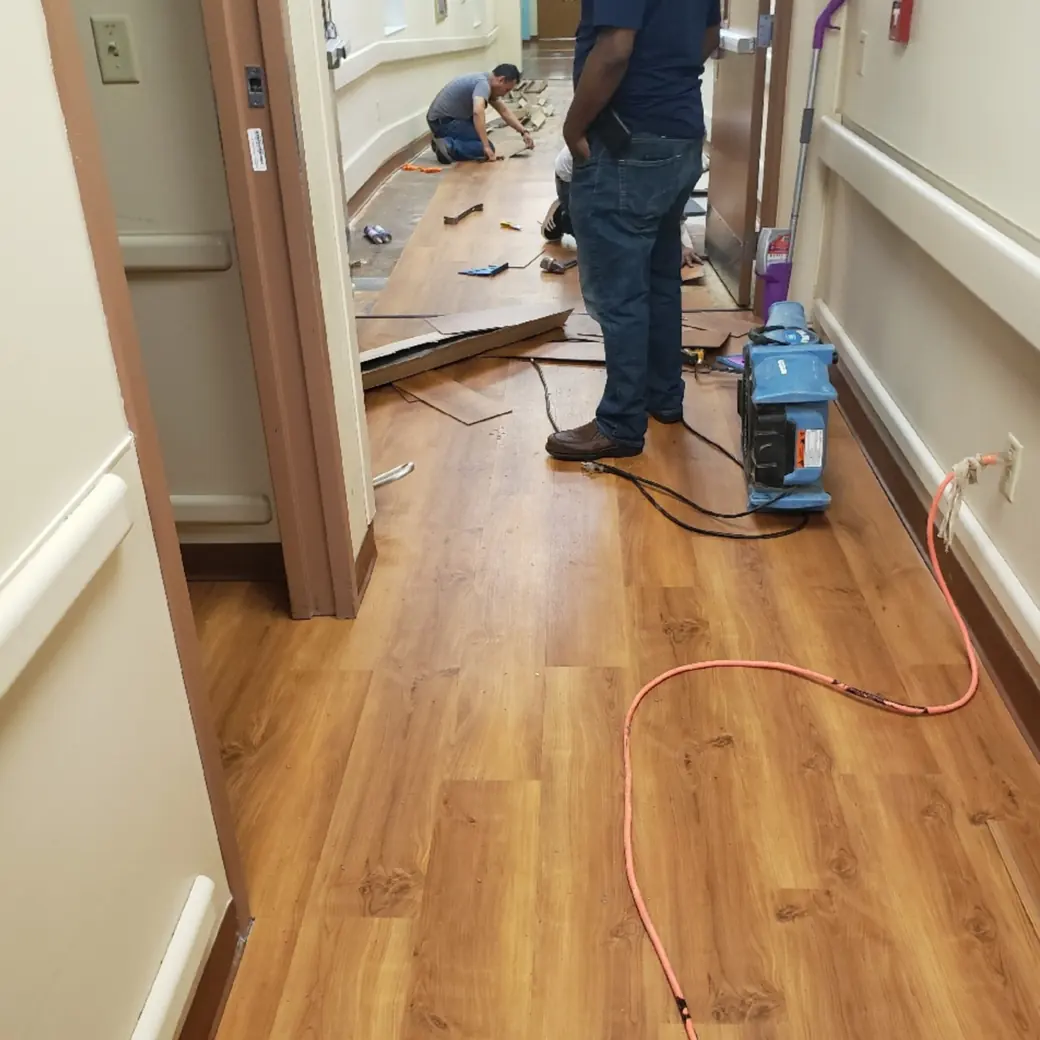
Commercial flooring should be selected around traffic, cleaning, moisture, acoustics, accessibility, operating downtime and substrate conditions—not appearance alone. Different zones in the same property may need different materials or installation methods.
Commercial flooring is easier to compare when every candidate is judged against the same requirements. For a Metro Atlanta office, shop or managed property, start with traffic, rolling equipment, cleaning, sound and access. Then compare the exact products and complete installation scopes.
A material category does not guarantee a reopening date, a maintenance cost or suitability for every commercial space. Use the intended use and current product documentation to narrow the choices.
LVP/LVT may be worth considering for suitable commercial areas where a resilient hard surface fits the use. Review the manufacturer's information for foot traffic, rolling chairs, carts, heavy fixtures and cleaning practices.
A wear-layer thickness alone does not establish performance under those conditions. Check the permitted installation method, substrate requirements and restrictions around fixed objects.
A waterproof product also does not waterproof the building. Moisture conditions below the surface and any active water problem still need the appropriate response.
Carpet tile may suit offices or other areas where comfort and modular replacement are useful priorities. Ask how the selected product handles the intended traffic, chairs and cleaning routine.
Local replacement depends on the installation and availability of compatible material. An unused tile may look different beside an aged surface. Discuss spare material and storage rather than assuming future replacements will always match.
Coordinate seams, layout and furniture moves before the work is scheduled. Installation around occupied workstations requires an agreed plan, not an assumption that desks can remain untouched.
Engineered hardwood can offer a real-wood surface where the exact product is suitable for the space. Compare its intended use, maintenance and vulnerability to the conditions at entrances or busy circulation routes.
Future sanding is not automatic. Construction, remaining usable surface, condition and previous work affect whether a floor can be refinished. Do not base a long-term cost comparison on an assumed number of sanding cycles.
If refinishing existing wood, discuss dust management and the selected finish's return-to-use instructions. These can affect furniture placement and reopening as much as the work itself.
Laminate may appear in comparisons for some commercial interiors, but products differ in intended use, liquid-exposure limitations and repair requirements. Review those details rather than assuming the category is always the cheapest or appropriate for every dry room.
Confirm that the proposed provider offers the exact product and installation scope. A comparison of materials is not a substitute for a project-specific proposal.
The floor is one part of the acoustic environment. Furniture, room geometry and the underlying building assembly also matter. If the building has specific acoustic requirements, obtain them before ordering.
Ask how the proposed assembly will be documented. A rating associated with an individual underlayment does not establish performance in every building. Additional layers must also be compatible with the flooring manufacturer's instructions.
Ask each proposal to identify removal, preparation, repairs, flooring, accessories, moving responsibilities and cleanup. Compare allowances and exclusions so that an apparently lower price is not simply missing required work.
Include the operational costs you actually expect, such as temporary closures or equipment moves, without assuming one material always provides the lowest lifetime cost. Confirm current availability and terms rather than relying on old promotional prices.
Agree on work areas, access, permitted hours and any practical phasing. Materials, substrate condition and product return-to-use requirements affect when a space can reopen. After-hours work and uninterrupted operations require confirmation for the specific project.
After a water loss, flooring putback follows completed mitigation, drying and any required remediation by others. Insurer approval remains separate from product selection and installation planning.
At handover, keep the installed product details, applicable warranty documents and exact cleaning instructions. Give that guidance to the people responsible for maintenance so that the chosen system is cared for appropriately.
Final Floors LLC has served Metro Atlanta since 2016 with flooring installation, commercial carpet tile and related preparation. To discuss commercial flooring options, visit FinalFloors.com, call 770-910-9719 or text 770-870-9876. Share the space's use, furniture and equipment, cleaning routine and access constraints.
Select around traffic, cleaning routine, moisture, acoustics, accessibility and operating downtime rather than appearance alone. Substrate conditions and the installation method matter as much as the surface material. Requirements differ by zone, so the same building often needs more than one specification.
Yes. An entry, a service corridor, a restroom and an office area typically carry different traffic, moisture and cleaning demands. Specifying each zone separately can outperform forcing one product across the whole property.
Look for removal, substrate preparation, moisture and flatness requirements, transitions, trim, access constraints and the planned working hours. Downtime assumptions should be stated, because phasing work around business hours changes the schedule and the scope.
Phasing is planned around the areas that must stay open, the daily hours available and the cure or return-to-use requirements of the selected system. Review the sequence, temporary transitions and protected access routes before work starts.
Call 770-910-9719 or use the online estimator with the property city or ZIP, the rooms involved and the current floor covering. Final Floors LLC reviews the details and confirms next steps for that property.
These sourced review excerpts are selected for relevance to commercial flooring across Metro Atlanta when matching evidence exists. Original service labels and source platforms are preserved; company-level feedback is not relabeled as a local project.
Customer review records: 236+ review records across sources as of 2026-11-13. This is not a unique-customer count.
Explore Final Floors customer reviews · Google Business Profile · BBB profile · Yelp profile · Angi profile
Use this Metro Atlanta flooring guidance to understand the decision, then confirm the recommendation against the actual property and written scope. Tell us about your existing floor, the result you want and any known preparation needs so we can help you plan the next step.
Start with: what you have now · what you want next · the property city or ZIP · desired timing.
Compare commercial flooring, post-mitigation repairs, LVP/LVT and whole-home options. Review the relevant service, then tell us your city and project details for an estimate.
Final Floors project examples: Commercial project proof · Water-loss flooring project proof · LVP project proof · Whole-home flooring project proof
Call 770-910-9719 or text 770-870-9876 for a project-specific estimate.