How to Compare Flooring Installation Bids in Metro Atlanta
By Final Floors LLC · Published · Updated
Compare three flooring installation bids line by line. Check preparation, materials, transitions, stairs, removal and protection before you sign.
Request a free project-specific estimate · Send your city, approximate area and photos.
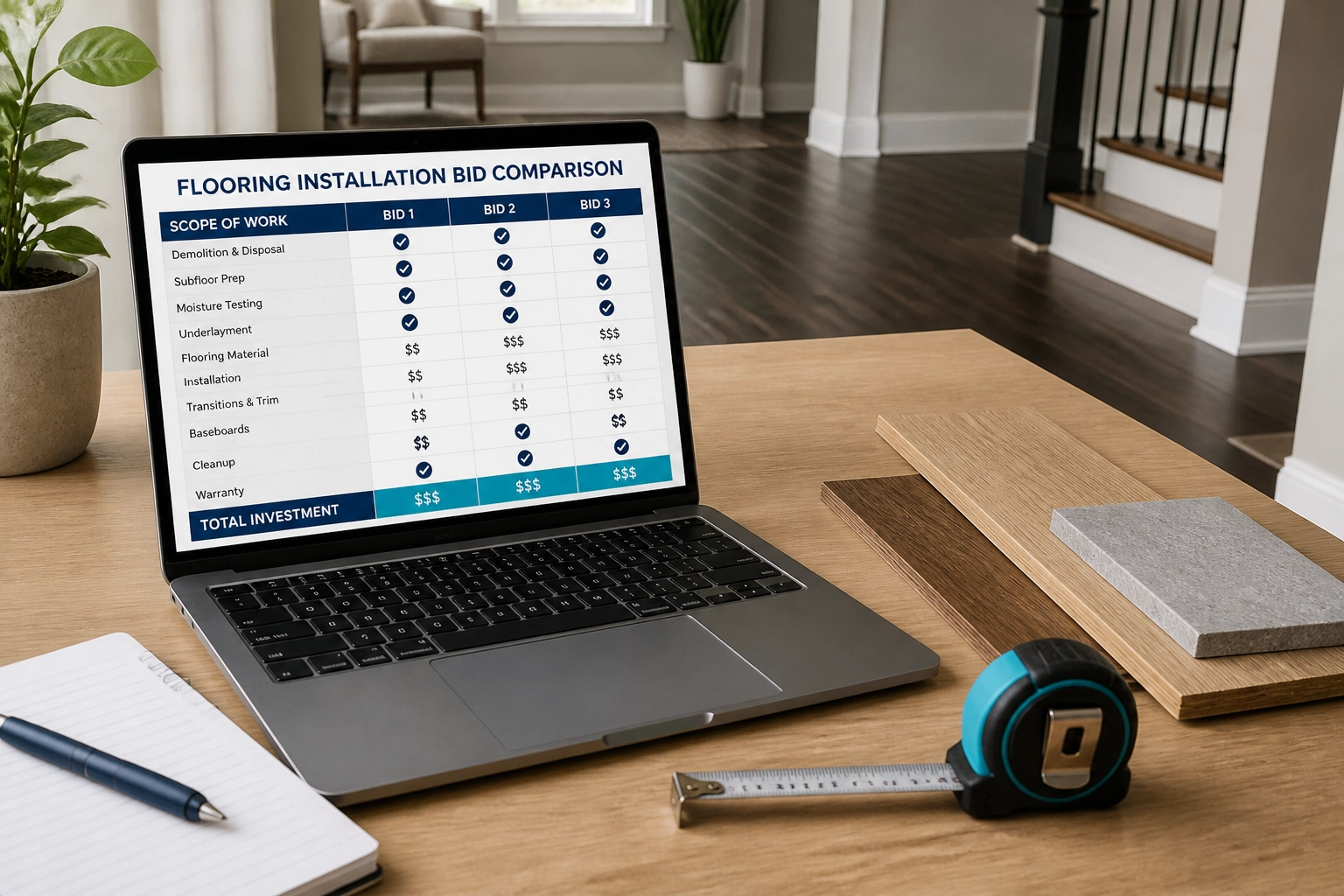
Three bids can look like three prices for the same floor. In Metro Atlanta, they often describe three different jobs. When you compare Atlanta flooring bids, the cheapest number may simply cover the least work. This post is a buyer-side checklist for reading three flooring bids side by side. You will learn how to build one comparison sheet, then check the same scope lines in every bid: site protection, removal and haul-away, subfloor evaluation and leveling, material specification and quantities, installation method and moisture, transitions and stairs, warranty and closeout, and payment terms. You will also see what to ask before signing, including condo, rental, and commercial details. Final Floors, LLC installs hardwood, LVP/LVT, carpet and commercial carpet tile, and provides subfloor repair and flooring replacement after mitigation, drying and any necessary remediation are completed by others. It does not perform water extraction, drying, mold remediation, or fire restoration. The goal is simple: compare the same lines, then compare the numbers.
Why Three Flooring Bids Can Describe Three Different JobsMost flooring proposals differ in what they spell out. A quote that looks $1,000 lighter often reflects a missing scope line, not a better deal on identical work.
Templates vary, so installation can mean laying material over a clean, flat subfloor or pulling carpet, repairing a subfloor, rebuilding a staircase and reusing baseboard.
Georgia treats bidding as contracting: O.C.G.A. § 43-41-2 includes "the negotiation of or bid or proposal for engagement or a contract," so expect a bid to name the contractor and scope.
Totals compare when the same lines appear in all three bids. The goal is the bid whose scope you can sign, not the smallest number. The lines hold for a Roswell condo, an East Cobb ranch, a Midtown rental turnover or a Duluth office build-out; B2B flooring Atlanta follows the same checklist.
Build One Comparison Sheet Before You Read a Single Bid
Before reading a total, build a simple grid. Use a separate row for each part of the job: site protection, removal and disposal, subfloor, material specification, installation method, transitions and stairs, warranty and closeout, payment terms. Add one column per bidder.
Copy each bidder's exact wording. "Prepare the subfloor" and "leveling included up to X bags" are different commitments, and paraphrasing hides that.
Flag every blank cell. A missing line is not free: it is excluded or assumed, and both cost you later. A prior leak makes this plain, so use the water-damage flooring replacement in Atlanta putback lines as a model.
Ask all three to quote the same rooms and the same product category, or the totals describe different jobs.
Put price last so scope comparison precedes the number, and keep signed, dated documents in one folder.
Line 1: Site Protection, Containment and Furniture Moving
On your comparison sheet, copy each bid's protection line. It should name protected rooms and materials: ram board, plastic sheeting, paper, corner guards and floor-to-floor protection along the haul path. It should list who moves what, including furniture, appliances, electronics, wall art, closet contents and fragile items, and state whether you empty the space or the crew moves and resets large items. For occupied homes, condos and offices, look for dust control, daily cleanup, and coverage of public hallways and elevator lobbies. For condo or mid-rise work, the bid should name the debris route, elevator use, who schedules the elevator, hallway protection and building notifications. A thin version says 'we protect your floors' and never mentions a piano, refrigerator or water heater closet. For carpet projects, this detail often appears in the carpet installation walkthrough.
Line 2: Removal, Haul-Away and Disposal
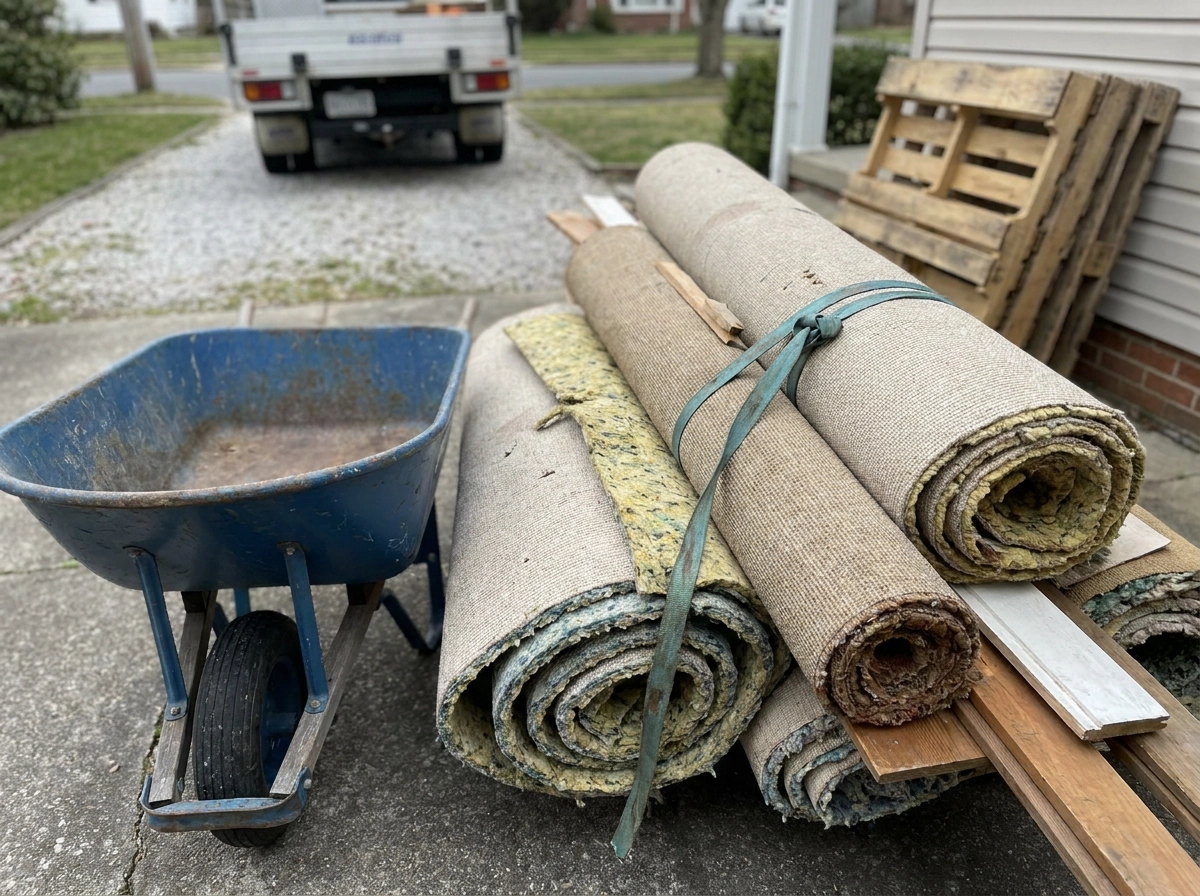
With the protection line settled, read the removal line next. It should name what gets removed: carpet and pad, tack strip, staples, existing LVP or laminate, hardwood, baseboard, thresholds, and leftover thinset or underlayment residue. Confirm who pays the dump fee, where debris goes, dumpster placement, driveway protection, and any condo or HOA rule about common-area debris. Ask whether removal is priced per square foot or as a lump sum, and whether stairs, closets, pantries, landings and laundry rooms count inside it or bill separately. Decide what happens to reusable material: salvaged hardwood, spare tile, extra carpet for patches, and baseboard worth reinstalling. If residue or damaged substrate turns up, subfloor repair pricing belongs in the same bid. A bid that omits removal is not cheaper; the work either stays with you or returns as a change order.
Line 3: Subfloor Evaluation, Repair and Leveling
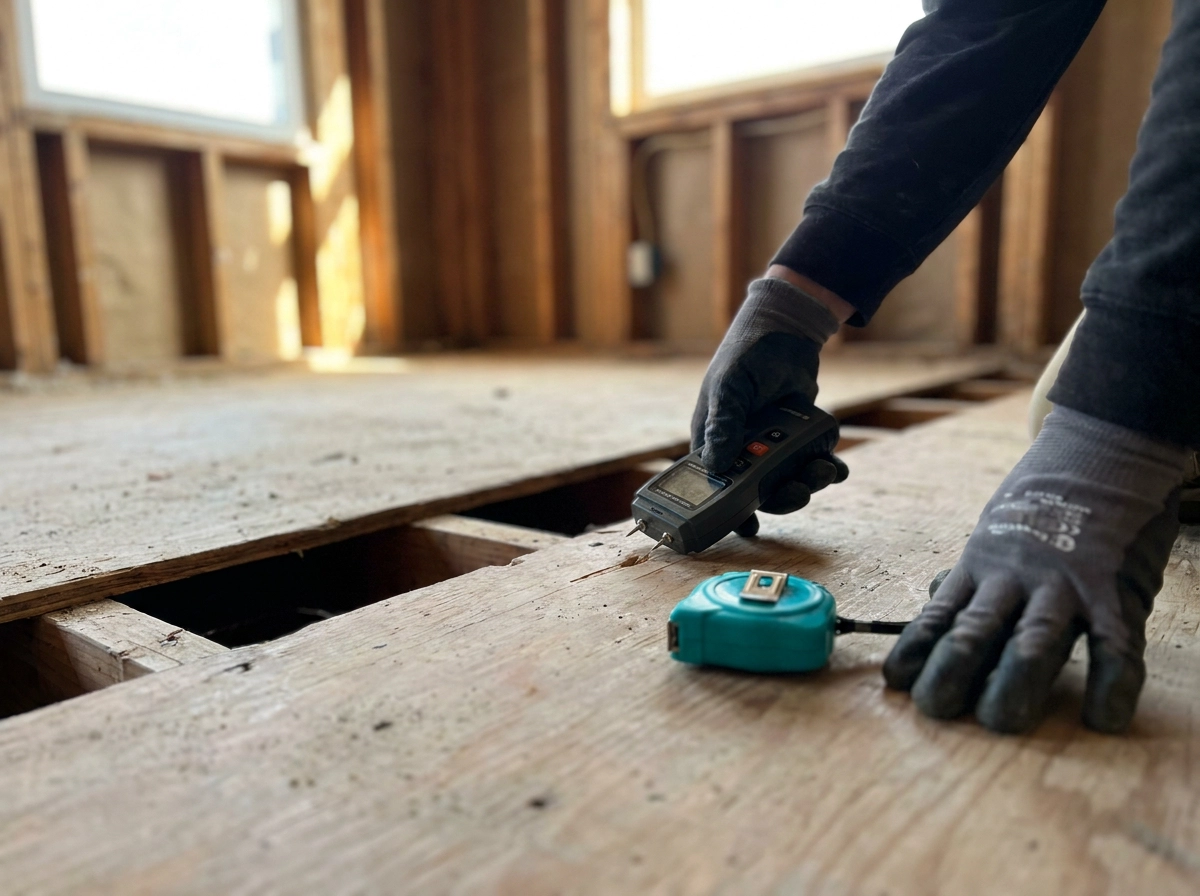
Once removal exposes the subfloor, the bid should say how it was evaluated: visual inspection, flatness checks, moisture testing, squeaks, deflection and any prior leak history in the room. How Final Floors Evaluates the Project is one example of that process written out.
Ask who owns the repair if conditions are worse than assumed, and request per-item pricing for leveling compound, plywood patching, damaged sheathing or joist work.
The bid should name the product and state that installation follows that manufacturer's written requirements for flatness, moisture, acclimation and substrate prep, not a bare number with no governing document. If a leak or appliance failure is in the history, it should name who handled mitigation and who handles flooring putback, since those are separate trades.
Finally, confirm whether subfloor repair and leveling is included, an allowance, or excluded.
Line 4: Material Specification and Quantities
Before comparing totals, confirm every bid names the material identically. Each should state category and construction (solid or engineered hardwood, LVP or LVT, carpet, commercial carpet tile or tile), the brand and style as the manufacturer lists it, such as Shaw, Mohawk or COREtec, plus thickness, wear layer or face thickness, plank dimensions, backing, pad or attached cushion, color, pattern and dye lot.
Quantities should be room-by-room with a stated waste percentage, naming who supplies material and who pays for overage or a short shipment. Ask whether the bid is a fixed specification or an allowance, and what that allowance covers per square foot and per room. What Can Change This luxury vinyl plank flooring Scope? clarifies the LVP line before comparing totals. Request labeled extras: attic stock for carpet tile, a spare plank box, unopened finish or stain.
Line 5: Installation Method, Moisture and Acclimation
Method comes next. Label each area: nail or staple down, glue down, floating, stretch-in carpet, glue-down carpet tile, or the setting method for your tile. Adhesive, underlayment, pad and fasteners must be the manufacturer's system for that exact product, not a generic glue-and-underlayment line. See how prep and method shift scope in this commercial LVP scope breakdown.
Moisture and acclimation should follow the manufacturer's written requirements for the exact product specified. If the bid does not name the governing document, ask before signing.
Site conditions the crew controls belong on the page: HVAC running before and after, temperature range during and after, and how doors and windows are managed while material is on site. Return-to-use guidance should state when furniture, heavy items, area rugs, moisture-generating appliances and pets return, and who hands it to you in writing.
Line 6: Transitions, Stairs and Detail Work
With method and moisture settled, move to the details easiest to undercount.
Name every transition by type and location: T-molds, reducers, thresholds and stair nosing, each tied to a specific doorway or height change, not a lump allowance.
For stairs, ask how many treads, risers and landings get new material, whether nosing is replaced, and whether the staircase is renovated or simply re-covered. Stair renovation is its own scope line, so a bid can include one and omit the other. For a sense of what shifts that scope, see what can change a staircase flooring and renovation scope.
Confirm trim too: baseboard removal and reinstall, quarter round, shoe molding, doorway undercutting, plus who caulks, touches up paint and closes gaps at the wall. Closets, pantries, laundry rooms and bath doorways are where these lines vanish.
Line 7: Warranty, Punch List and Closeout
Trim questions settled, closeout decides whether the bid is finished. Compare two warranties separately: the manufacturer's product warranty and the installer's workmanship warranty. Get each term and what it covers in writing from every bidder. Finish warranties for Bona, DuraSeal or Rubio Monocoat belong to refinishing or screen-and-recoat, a separate service; don't assume an installation bid carries them. Ask who walks the finished job with you, how corrections are scheduled, and the contract's response window. Confirm debris, cardboard, offcuts and tape residue leave with the crew, and that extra material is returned labeled. Read exclusions: conditions found after removal, moisture events after installation, furniture moved back too early, and owner-supplied material that fails. Record each answer on your comparison sheet.
What the Money Section Should Say: Payment, Deposits and Georgia Law
Compare the money mechanics side by side. Line up the deposit amount, whether a deposit is due before material is ordered, progress payments tied to named milestones, and final payment tied to completion and your walkthrough, not a posted date. Ask how change orders are priced before extra work starts and what an allowance does to the total.
Georgia's Prompt Payment Act (O.C.G.A. §§ 13-11-1 to 13-11-11) excludes contracts for residential improvements with 12 or fewer units, covering most single-family work. Those schedules come from your signed agreement. Where the Act applies, defaults are 15 days for owners (§ 13-11-4(a)), 10 days for primes paying subs (§ 13-11-4(b)), and 1% monthly interest only with notice (§ 13-11-7(a)). Parties may contract otherwise, and those terms control. Verify current statute text; treat these as covered-project defaults, not home-job norms.
Condos, Rentals and Commercial Spaces: Extra Bid Lines
Condos, rentals and commercial jobs add scope lines. HOA and condo bids should list board or manager approval, certificate of insurance, elevator reservation, working hours, noise limits and hallway debris rules. Apartment turnovers add unit-by-unit scheduling, carpet and pad quantities, key handling, and how occupied versus vacant units are sequenced.
Commercial bids should name commercial carpet tile and LVP, after-hours or phased scheduling, and protection for fixtures that stay in place. Compare multi-unit bids per unit type and per area, not one blended square-foot total; request quantities split by unit plan. Water-mitigation putback is a separate set of lines: extraction, drying and remediation sit with one party, flooring replacement with another. Final Floors installs hardwood, LVP/LVT, carpet and commercial carpet tile, and handles flooring replacement after mitigation, drying and any necessary remediation are completed by others. Final Floors does not provide extraction, drying, mold remediation or fire restoration. Those lines belong on the same comparison sheet.

Questions to Send Every Bidder Before You Sign
Once your condo, rental or commercial lines are set, send every bidder the same questions in writing and file each reply beside your comparison sheet. Confirm in writing whether subfloor repair and leveling, removal, disposal, transitions, stair details, and site protection are included or excluded from the quoted total. Ask which product is specified and which manufacturer installation document governs moisture, flatness, acclimation, and adhesive for that exact product. Request the payment schedule, change-order rates, what triggers final payment, and how late material affects the schedule. Ask who moves furniture and appliances, patches drywall, removes and reinstalls baseboard, and removes debris from your property. Get the workmanship warranty term, punch list process, and return-to-use instructions. Drop every answer into the same comparison sheet before you sign.
Frequently Asked Questions About Comparing Flooring Bids
Is the lower bid lower because it is smaller? Count the scope lines. Missing prep, removal, stair work or transitions explains the gap.How many written flooring estimates should I compare? Start with at least two proposals for the same rooms and materials. A third can help when the scope or allowances still don’t match.
My home has stairs. What should the bid include? Treads, risers, landings and nosing as their own line. Stair renovation is separate from installation.
Can I compare an allowance with a fixed price? Only after converting the allowance into one specific product. Until then the totals describe different material.
What if the subfloor is worse than assumed? Ask how extra work is priced before signing. Subfloor repair and leveling is often priced per item or as a stated allowance.
Who handles water damage before new flooring goes in? Mitigation such as extraction, drying and remediation is separate from flooring putback, and the bid should name who does which.
Does this checklist work for multi-unit bids? Yes. Compare per unit and per area, and scope common-area carpet tile and LVP separately.
Compare the Same Lines, Then Compare the Numbers
Line up protection, removal and disposal, subfloor, material specification, installation method, transitions and stairs, warranty, and payment terms before reading any total. About twenty minutes with three bids on one table.
The lowest number is only the lowest price when scope matches. Otherwise it is a smaller project, and the missing work returns as a change order or as your weekend. Ask for the difference in writing: what is excluded, and what adding it costs. That gives you something you can compare and sign.
Ready to set a real scope beside the other bids? Send your city or area, existing floor and a few photos. Final Floors is family-owned, based in Roswell and serving Metro Atlanta since 2016, with free project-specific estimates and mobile material selection. Call 770-910-9719, text 770-870-9876, or request an estimate at finalfloors.com.
Deciding on scope? Start with the flooring installation service page and the project match tool before collecting quotes.
Conclusion
Comparing flooring bids in Metro Atlanta is less about the total and more about the scope behind it. Build one comparison sheet, then walk the same lines for protection, removal and disposal, subfloor prep, material specification, installation method, transitions, warranty and payment terms. When the scope matches, the numbers finally mean something. Where a bid is silent, ask what is excluded and what adding it costs in writing before you sign.
Final Floors is family-owned, based in Roswell and serving Metro Atlanta since 2016, with free project-specific estimates and mobile material selection. Share your city or area, existing floor and a few photos, then call 770-910-9719, text 770-870-9876 or request an estimate at finalfloors.com. A clear scope today saves the change order later.