What decision does this article help with?
Wide Plank White Oak Installation Atlanta Humidity Guide — flooring insights from Final Floors LLC, serving Metro Atlanta since 2016. 4.9★ Google · BBB A+
Loading your flooring page…
Helpful guides for your flooring decision
Plan furniture pads and everyday care to protect your hardwood finish.
Understand the refinishing process, cost considerations and timing before your estimate.
Wide Plank White Oak Installation Atlanta Humidity Guide — flooring insights from Final Floors LLC, serving Metro Atlanta since 2016. 4.9★ Google · BBB A+ Use the related Final Floors service, city and project links on this page if the topic matches a real Metro Atlanta flooring project. Call 770-910-9719 for a project-specific estimate.
Start Project Match · View Final Floors projects · Call 770-910-9719
Wide Plank White Oak Installation Atlanta Humidity Guide — flooring insights from Final Floors LLC, serving Metro Atlanta since 2016. 4.9★ Google · BBB A+
Visit Hardwood Flooring Installation for the related flooring service and project-planning details. This article provides general guidance; the written scope and estimate are specific to your property.
Use Project Match to send the project city, flooring type, approximate scope and known site conditions directly to Final Floors, LLC. A written estimate controls the actual scope, recommendation and price.
Start Project Match · View real Final Floors projects · Call 770-910-9719
Final Floors LLC · Metro Atlanta Flooring Education
Flooring education from Final Floors LLC
Expert wide plank white oak Atlanta installation. Prevent cupping with NWFA glue-assist specs and moisture barriers. Call Final Floors LLC at 770-910-9719.
Published 2026-08-06 · Updated 2026-08-10
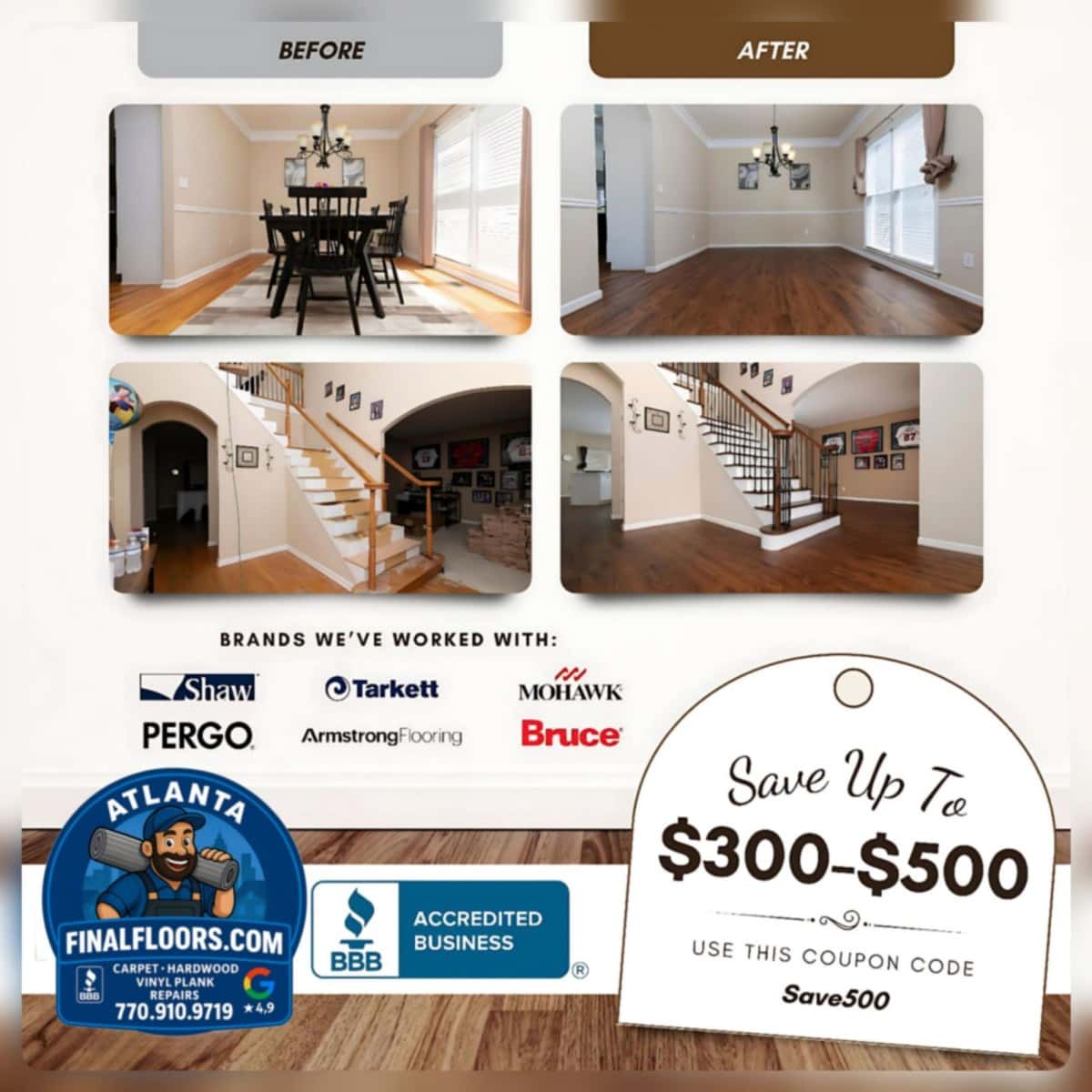
Hardwood installation starts with the property conditions, not the sample board. Wood construction, substrate type, moisture readings, acclimation requirements, installation method, transitions and indoor conditions determine whether solid or engineered hardwood is the better fit.
Can I install 7-inch wide plank hardwood in Atlanta without it cupping? The short answer is **yes**, but it requires a specialized "Glue-Assist" installation method and strict adherence to National Wood Flooring Association (NWFA) moisture standards. In Atlanta’s 70%+ summer humidity, traditional nailing alone is insufficient for planks wider than 5 inches. To prevent cupping, you must ensure the moisture content (MC) difference between your white oak planks and the subfloor is 2% or less, utilize a moisture-cured urethane adhesive alongside mechanical fasteners, and install a high-performance Class II vapor retarder. At Final Floors LLC, we have spent over 20 years perfecting these techniques to ensure your luxury wide-plank floors remain stable through Georgia's volatile seasons.
Atlanta, Georgia, is notorious for its "subtropical" climate, characterized by an average relative humidity (RH) of 68% to 72% during the peak summer months. For a hygroscopic material like White Oak, this environment is a constant challenge. Wood is a living material that expands as it absorbs moisture and contracts as it releases it. In neighborhoods like Buckhead (30305) and Sandy Springs (30328), where large estates often feature crawl spaces or slab-on-grade foundations, the moisture gradient can be extreme.
When you install a 7-inch wide plank, the surface area available for moisture absorption is significantly larger than a standard 2.25-inch strip. If the bottom of the board absorbs moisture from a damp crawl space while the top is dried by your HVAC system, the board will "cup"—the edges will rise higher than the center. This isn't just an aesthetic issue; it can lead to structural failure, finish cracking, and permanent wood cell deformation. Understanding the physics of wood expansion in the Southeast is the first step toward a successful hardwood floor installation. We track the Equilibrium Moisture Content (EMC) daily on our job sites to ensure the environment is stabilized before a single board is laid.
The National Wood Flooring Association (NWFA) provides the gold standard for installation, and for wide plank flooring (defined as boards 5 inches or wider), the rules are much stricter than for narrow strips. For standard 2.25-inch flooring, a 4% moisture content difference between the flooring and the subfloor is acceptable. However, for 7-inch wide plank white oak in Atlanta, the NWFA mandates a **maximum 2% difference**.
At Final Floors LLC, our in-house flooring crews use professional-grade pin-type moisture meters to take at least 40 readings per 1,000 square feet of flooring. We don't just test the wood; we test the subfloor in multiple zones, especially near exterior walls and plumbing fixtures. If your subfloor is at 10% MC, your white oak must be between 8% and 12% before we begin. If these numbers don't align, we pause the project. This level of discipline is why we maintain an A+ BBB rating and have in over nine years of operation. We refuse to rush a process that requires biological and environmental synchronization.
In the past, flooring was simply nailed or stapled. But as Atlanta homeowners moved toward the modern aesthetic of 7-inch, 8-inch, and even 10-inch wide planks, the industry realized that nails alone couldn't hold the tension of a wide board's expansion. This is where the "Glue-Assist" method becomes mandatory. Glue-assist involves applying a professional-grade wood flooring adhesive to the subfloor in conjunction with traditional cleats or staples.
There are three primary methods we use at Final Floors LLC:
• **Serpentine Method:** A bead of glue is applied in a continuous S-shape on the back of the board or the subfloor.
• **Parallel Strip Method:** Beads of glue are run parallel to the length of the board.
• **Full Trowel Glue-Assist:** The most robust method, where adhesive is spread across the entire subfloor using a notched trowel.
For 7-inch planks in high-humidity areas like Vinings or Brookhaven, we typically recommend the full trowel or heavy serpentine method. This creates a secondary bond that prevents the board from lifting or cupping even when the humidity spikes. We use high-performance adhesives from brands like Bostik or Mapei, which offer a high PSI shear strength and integrated moisture vapor protection.
Moisture-control requirements depend on the subfloor, site conditions and selected flooring system. A vapor retarder does not prevent leaks or flooding. In Georgia, we deal with two main types of subfloors: plywood/OSB over a crawl space and concrete slabs. Each requires a specific moisture retarder specification.
For wood subfloors, we utilize Class II vapor retarders like Aquabar "B" or silicone vapor shields. These materials have a perm rating between 0.1 and 1.0, which allows the wood to "breathe" slightly while blocking the bulk of moisture migration from the crawl space. For concrete slabs—common in newer Sandy Springs developments—we often specify a liquid-applied moisture vapor barrier. These membranes are engineered to withstand up to 15-25 lbs of MVER (Moisture Vapor Emission Rate) or 95-100% Relative Humidity within the slab.
| Barrier Type | Perm Rating | Best Use Case | |:--- |:--- |:--- | | Aquabar "B" | 0.87 | Plywood subfloors over conditioned crawl spaces | | 6-mil Polyethylene | <0.1 | Underlayment for floating floors only | | Liquid Urethane Membrane | <0.1 | Glue-down wide plank on concrete slabs | | Silicone Vapor Shield | 0.5 | High-end residential nail-down applications |
A common mistake made by inexperienced contractors is simply dropping the wood in the house for three days and assuming it's ready. In Atlanta, acclimation is a process, not a timeframe. The wood must reach its Equilibrium Moisture Content (EMC) relative to the home's permanent living conditions. This means the HVAC system must be operational and set to the homeowner's typical preference (usually 68-72 degrees and 35-55% humidity) for at least 7-10 days before the wood even arrives.
Once the white oak is on-site, we cross-stack the bundles to allow for maximum airflow around each board. We monitor the internal temperature and humidity of the home using digital hygrometers. If you are working with an insurance carrier like State Farm or Allstate on a claim, they often look for these specific logs to validate the warranty. Final Floors LLC provides this documentation as part of our standard operating procedure, ensuring your project-specific written scope and applicable warranty information is fully backed by data.
Wide plank flooring is extremely unforgiving of uneven subfloors. If there is a dip in the plywood, a 7-inch board will bridge that gap, creating a hollow sound and eventually causing the tongue-and-groove joint to fail. The NWFA requires subfloors to be flat within 3/16 of an inch over a 10-foot radius.
In many Metro Atlanta homes, settling is common due to the shifting nature of our red clay soil. Before installing wide plank white oak, we often perform subfloor repair and leveling. This may involve sanding down high spots in the OSB or using self-leveling underlayments with a minimum compressive strength of 3,000 PSI. For Buckhead renovations, we frequently find that older joists need sistering to provide the structural rigidity required for heavy wide-plank white oak. A stable floor starts from the ground up, and we never install over a compromised foundation.
While solid white oak is the traditional choice, engineered white oak is often the superior option for Atlanta's humidity. Engineered flooring is constructed with a real white oak wear layer over a multi-ply, cross-grained plywood core. This cross-grain construction counteracts the natural tendency of wood to expand and contract, making it significantly more stable than solid wood.
For planks 7 inches or wider, we often recommend high-end engineered products from manufacturers like Shaw, Mohawk, or Mannington. These products feature a 4mm to 6mm wear layer, allowing them to be refinished just like solid wood, but with the added benefit of being able to be glued directly to concrete slabs. In the humid environment of Sandy Springs, an engineered wide plank offers peace of mind that solid wood simply cannot match, especially in basement or terrace-level installations.
Investing in wide plank white oak is a significant financial commitment that adds substantial equity to your home. In 2026, Metro Atlanta pricing for premium wide plank installation reflects the increased labor and material costs associated with glue-assist and moisture management.
| Service Component | Estimated Cost (per sq. ft.) | |:--- |:--- | | Premium 7" White Oak Material | $8.00 - $12.00 | | Professional Installation (Glue-Assist) | $4.00 - $6.00 | | Subfloor Prep & Leveling | $1.50 - $3.00 | | Moisture Barrier/Adhesive Materials | $1.00 - $2.00 | | **Total Estimated Investment** | **$14.50 - $23.00** |
While these prices may be higher than a standard "nail-down" job from a subcontractor-based company, the longevity of the floor is doubled. At Final Floors LLC, we use only in-house flooring crews, ensuring that the person installing your floor is personally invested in the outcome and trained in these specific Atlanta-centric techniques. We also We can provide project-specific flooring documentation for insurance-related projects.
Once your wide plank white oak is installed, the responsibility shifts to maintaining a stable environment. We advise all our clients in Vinings and Smyrna to invest in a whole-home dehumidification system or, at the very least, a high-quality standalone dehumidifier for the crawl space or basement.
During Atlanta's "dog days" of summer, your AC alone may not remove enough moisture to keep the RH below 55%. If the humidity inside your home stays at 70% for several weeks, even the best glue-assist installation will be tested. We recommend using a digital hygrometer to monitor your indoor climate. If you notice slight gaps in the winter, don't panic—this is normal contraction. However, if you see the edges of your 7-inch planks beginning to rise in July, call us immediately at 770-910-9719. Early intervention can often save a floor from permanent cupping through professional-grade dehumidification and stabilization.
Call 770-910-9719 for a free in-home estimate, or request a quote online.
These sourced review excerpts are selected for relevance to flooring projects across Metro Atlanta when matching evidence exists. Original service labels and source platforms are preserved; company-level feedback is not relabeled as a local project.
Customer review records: 215+ review records across sources as of 2026-09-22. This is not a unique-customer count.
Explore Final Floors customer reviews · Google Business Profile · BBB profile · Yelp profile · Angi profile
Use this Metro Atlanta flooring guidance to understand the decision, then confirm the recommendation against the actual property and written scope. Tell us about your existing floor, the result you want and any known preparation needs so we can help you plan the next step.
Start with: what you have now · what you want next · the property city or ZIP · desired timing.
Compare commercial flooring, post-mitigation repairs, LVP/LVT and whole-home options. Review the relevant service, then tell us your city and project details for an estimate.
Final Floors project examples: Commercial project proof · Water-loss flooring project proof · LVP project proof · Whole-home flooring project proof
Call 770-910-9719 or text 770-870-9876 for a project-specific estimate.