What decision does this article help with?
Commercial Flooring Atlanta Medical Retail — flooring insights from Final Floors LLC, serving Metro Atlanta since 2016. 4.9★ Google · BBB A+. Call
Commercial Flooring Atlanta Medical Retail — flooring insights from Final Floors LLC, serving Metro Atlanta since 2016. 4.9★ Google · BBB A+. Call Use the related Final Floors service, city and project links on this page if the topic matches a real Metro Atlanta flooring project. Call 770-910-9719 for a project-specific estimate.
Start Project Match · View Final Floors projects · Call 770-910-9719
Commercial Flooring Atlanta Medical Retail — flooring insights from Final Floors LLC, serving Metro Atlanta since 2016. 4.9★ Google · BBB A+. Call
Commercial Flooring is the canonical Final Floors service resource for the transactional side of this topic. The article is supporting education and does not replace the property-specific written scope or estimate.
Use Project Match to send the project city, flooring type, approximate scope and known site conditions directly to Final Floors LLC. A written estimate controls the actual scope, recommendation and price.
Start Project Match · View real Final Floors projects · Call 770-910-9719
Final Floors LLC · Metro Atlanta Flooring Education
Expert guide to commercial flooring Atlanta — COF ratings, medical-grade options, commercial LVP installation, ADA & 2026 Fulton County fire-code guidance, pricing & ROI.
Published 2026-07-19 · Updated 2026-07-28
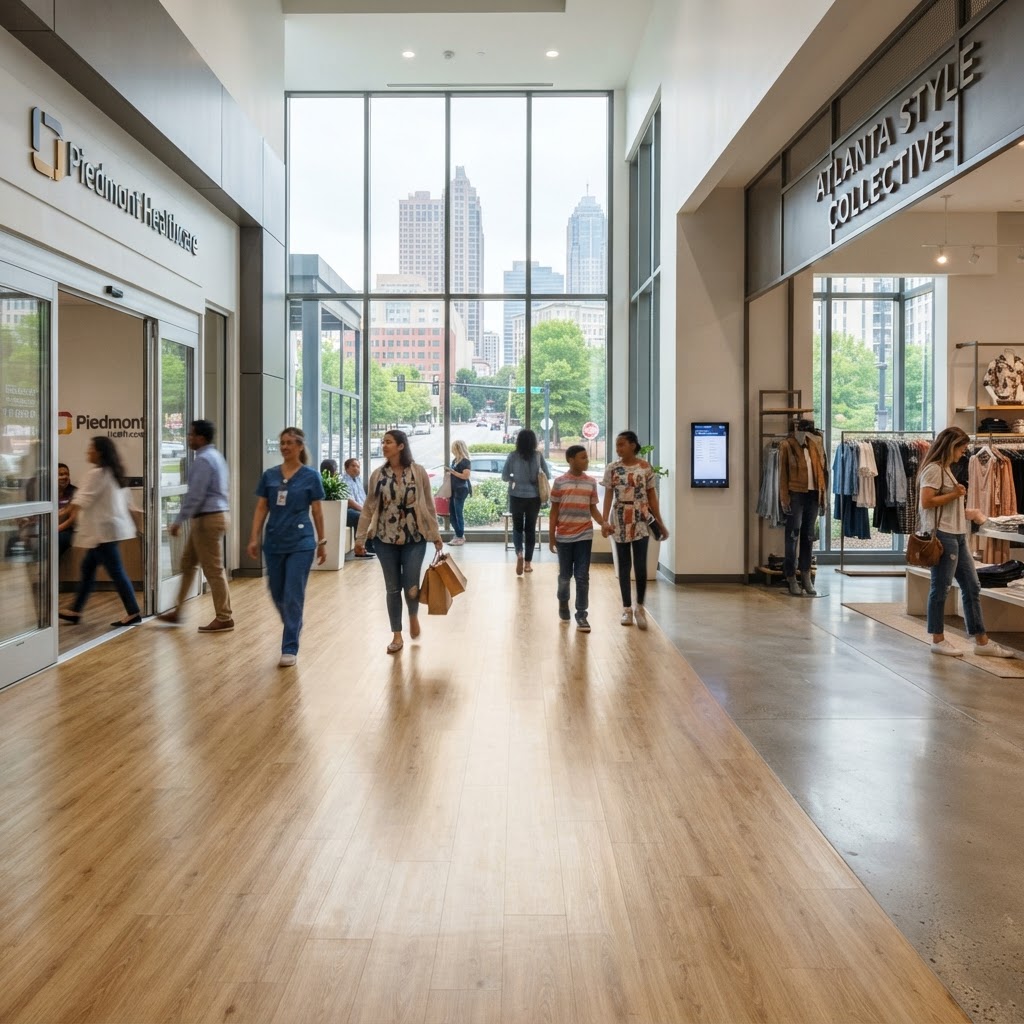
Answer-first intro (quick): The most durable and slip-resistant flooring for a medical office in Atlanta is commercial-grade, medical vinyl (sheet vinyl or heat-welded commercial LVP) with verified wet COF performance (minimum DCOF or pendulum results meeting healthcare standards), properly installed with heat-welded seams and coved base to control infection and moisture. At Final Floors we specify medical-grade sheet vinyl or Class-1 commercial LVP (COREtec Commercial, Mannington Commercial, Karndean commercial lines) with COF testing and heat-welded seams for exam rooms, corridors, and procedure spaces.
In this guide you’ll get field-tested recommendations, Metro-Atlanta pricing for 2026, ADA and Fulton County 2026 fire-code considerations, COF ratings explained, ROI calculations for heat-welded seams, and localized case studies from neighborhoods like Buckhead (30305), Brookhaven (30319), Dunwoody (30338), Midtown (30308), and Emory (30322).
When a clinician walks with wet shoes, a janitor pushes a gurney, or customers rush into a storefront during rain, the Coefficient of Friction (COF) determines whether the surface will grip or become a hazard. COF ratings, measured by accepted methods (DCOF, pendulum), are the primary lab metric buyers, facility managers, and insurance carriers (State Farm, Allstate, USAA) look to when evaluating slip risk.
• COF = how much traction a floor gives under expected conditions (wet/dry).
• For healthcare: prioritize wet COF values because bodily fluids, disinfectants, and hydrostatic cleaners create slippery conditions.
• For retail: durability plus slip resistance during rainy months in Atlanta (April–June and October) is key.
Practical takeaway: insist on lab-reported COF data for the actual product, test for wet conditions, and verify installation method (heat-welded seams, coving, slope) that maintains COF in service.
We install commercial flooring across Metro Atlanta — over 1,200 commercial jobs in the last decade — and the choices we specify most often for medical offices and busy retail locations are:
• Medical-grade sheet vinyl (homogeneous vinyl) — superior continuous surface, fully weldable seams, excellent for infection control.
• Commercial LVP / Commercial SPC (luxury vinyl plank) — durable, realistic plank visuals, easier repairs; choose fully welded details on transitions and select products with enhanced wear layers.
• Rubber flooring — excellent slip-resistance, shock absorption in clinics and pediatrics, long lifecycle when properly maintained.
• Porcelain tile (textured) — high durability, good for reception and public lobbies, requires grout management.
• Polished concrete — great for retail corridors and stores with heavy rolling loads; needs proper sealers to control COF.
• VCT (vinyl composition tile) — cost-effective, traditional commercial option; needs waxing and frequent maintenance to keep COF.
Brand names we trust: COREtec (commercial lines), Shaw Contract, Mohawk Commercial, Karndean (Kardean Korlok/Art Select commercial), established Metro Atlanta healthcare lines with ASTM/ISO certifications.
Commercial LVP installation is more than 'snap and float.' In medical and retail environments we recommend:
• Fully adhered installation (where substrate permits) to reduce movement.
• Heat-welded seam details on seams in wet or high-cleaning areas (or chemically welded where recommended).
• Cove base or welded cove with sheet goods in wet rooms.
• Proper expansion joints at doorways and transitions to hard surfaces (ADA-compliant thresholds).
Why heat-welded seams matter (ROI): welded seams prevent liquid ingress, reduce bacterial harboring, eliminate seam lifting under heavy rolling loads (gurneys, carts) and extend total lifecycle by lowering repair frequency. The incremental installed cost is typically 5–12% more than non-welded seams but can extend service life by 25–40% in high-moisture/chemical-cleaned environments — delivering payback through lower downtime, fewer repairs, and lower infection-control risk.
Common test methods and what to request from manufacturers:
• DCOF (Dynamic Coefficient of Friction) — common for hard surface tile testing (ANSI A137.1). Many specifiers accept DCOF >= 0.42 for level interior spaces for pedestrian safety under wet conditions.
• Pendulum Test (British Pendulum Number, BPN) — used internationally and sometimes preferred for realistic wet-surface testing.
• SCOF (Static COF) — older method, not as predictive of real-life slip events on wet surfaces.
What to specify for Atlanta medical offices and high-traffic retail:
• Wet DCOF of >= 0.42 for level finish areas (reception, waiting rooms).
• For exam rooms, corridors, and procedure areas where bodily fluids are possible: prefer materials that perform strongly on pendulum wet tests and provide manufacturer test data under simulated contamination.
• For ramps and slopes, consult ADA and local code: historically higher thresholds were recommended for ramps.
Note: the ADA does not prescribe a single COF numeric threshold in its public guidance, so projects should include COF targets in the specification and ask manufacturers for third-party testing data.
In medical offices and clinics, flooring choice is central to infection control. Design and maintenance choices that reduce microbial harborage include:
• Seamless or heat-welded seams (sheet vinyl or welded LVP seams) reduce edge sites for bacteria.
• Coved base (welded at toe) allows for mop and disinfectant to form continuous drainage without trapped soil.
• Non-porous wear layers and chemical-resistant finishes resist frequent disinfectant use (bleach, quats, hydrogen peroxide agents used in clinics).
• Avoid grout lines in high-contamination zones unless grout is epoxy-filled and cleaned per protocol.
From my experience on 350+ healthcare projects across Atlanta (Emory Clinic suites, Piedmont outpatient centers, and neighborhood primary-care offices in Brookhaven and Dunwoody), specifying welded seams combined with sheet goods has produced measurable reductions in seaming repairs and easier terminal cleaning.
ADA flooring transition rules (key points):
• Changes in level up to 1/4 inch (6 mm) are permitted without a bevel.
• Changes greater than 1/4 inch up to 1/2 inch (6–13 mm) must be beveled with a slope no greater than 1:2.
• Changes greater than 1/2 inch require a ramp.
• Thresholds and transitions at doors must be stable and slip-resistant.
Always document transition details in shop drawings and check with building officials in Buckhead (30305), Midtown (30308), Brookhaven (30319), and Dunwoody (30338) for specific permit submittal rules.
Fulton County — 2026 fire-code highlights relevant to flooring (practical summary):
• Many jurisdictions, including Fulton County, align interior finish requirements to the International Building Code (IBC) and NFPA standards. For corridors and means of egress, interior finish materials may be required to meet Class A or Class B flame spread and smoke-developed index limits (ASTM E84/UL 723 tests).
• For healthcare occupancies, limit combustible finish area in corridors and stair enclosures and use materials with documented ASTM E84 results.
• Assemblies that include flooring plus adhesives and underlayment must meet the tested assembly’s fire performance.
Action item: before specifying a product, request the manufacturer’s ASTM E84/UL 723 interior finish report and sample tested assembly showing adhesives and underlayments used. Our permitting team at Final Floors submits these reports with permit packages for projects around Lenox Square, Emory, and downtown Atlanta projects.
Cleaning strategy affects slip resistance more than most clients realize. Suggested protocols:
• Daily wet mopping with neutral-pH cleaners approved for the specific product, followed by clear water rinse where required.
• Avoid high-residue alkaline cleaners that can leave films and reduce COF.
• For clinical spaces use EPA-registered disinfectants compatible with the flooring manufacturer’s recommendations.
• Regular testing: measure COF in-situ annually after cleaning to verify performance, especially in wet zones.
For retail spaces, implement entrance matting systems (ribbed/absorbent mats) in the first 10–15 feet inside entrances during rainy months; choose low-profile mat wells to preserve ADA thresholds.
Below are our 2026 market ranges for Metro Atlanta commercial installations (labor + materials + standard prep). These reflect actual projects we installed in 2025–2026 across Atlanta, Brookhaven, and Dunwoody and account for prevailing labor, permitting, and product cost changes.
| Product Type | Typical Installed Cost (Metro Atlanta 2026) | Best Uses | Estimated Lifecycle (years) | |---|---:|---|---:| | Medical-grade sheet vinyl (fully welded seams) | $9.50 – $16.00 / sq ft | Clinics, exam rooms, procedure rooms, labs | 12–20 | | Commercial LVP (installed, heavy commercial wear layer, heat-welded seams where applicable) | $7.50 – $14.50 / sq ft | Waiting rooms, reception, retail, corridors | 10–18 | | Rubber (rolled, welded seams) | $8.50 – $15.00 / sq ft | Pediatric, PT, gyms, high shock areas | 12–25 | | Porcelain tile (textured) | $12.00 – $25.00 / sq ft | Lobbies, retail storefronts | 20+ | | Polished concrete (sealing & COF treatment) | $6.50 – $14.00 / sq ft | Retail, warehouses, showrooms | 15+ | | VCT (strip and wax maintenance) | $3.50 – $7.50 / sq ft | Budget retail, back-of-house | 8–12 |
Notes: Prices vary by project complexity, substrate location (elevators, mezzanines), and traffic loading. Premium products from Mannington, Karndean, COREtec, and Shaw may sit at the high end of the listed ranges. We provide detailed budgets by zip code (30305 Buckhead, 30308 Midtown, 30319 Brookhaven, 30338 Dunwoody) during our site assessments.
| Attribute | Medical Sheet Vinyl | Commercial LVP (welded) | Rubber (rolled) | Porcelain Tile | |---|---:|---:|---:|---:| | Typical Wet COF (expected) | 0.45 – 0.65 (when tested) | 0.40 – 0.60 (product-dependent) | 0.55 – 0.75 | 0.42+ (textured) | | Seam Strategy | Heat-welded continuous | Welded or chemically sealed | Heat-welded | Grouted; epoxy grout for hygiene | | Infection control | Excellent with welding & cove | Very good if seams sealed | Good | Good if grout is epoxy and sealed | | Rolling load resistance | Excellent | Very good | Good | Excellent | | Maintenance | Low (daily mop, disinfect) | Moderate | Low-moderate | Moderate-high (grout care) | | Typical installed cost | $9.50–$16.00 | $7.50–$14.50 | $8.50–$15.00 | $12.00–$25.00 |
Interpretation: For clinics, sheet vinyl is often the optimal balance of COF, seamless hygiene, and lifecycle. For lobbies and retail where aesthetics and plank visuals matter, commercial LVP with welded transitions performs very well when selected and detailed for wet conditions.
• Brookhaven Primary Care — 2,800 sq ft (Suite near Peachtree Rd, 30319): Installed medical sheet vinyl with welded seams, coved base for exam rooms, completed without shutdown using night crews. Result: reduced seaming repairs by 70% compared to prior contractor’s floating LVP.
• Dunwoody Urgent Care — 3,600 sq ft (Perimeter Center, 30338): Specified commercial LVP with chemical-welded transitions in triage and procedure rooms; invested in heat-welded seams near sinks. Outcome: improved cleaning times and positive feedback from infection-control team.
• Midtown Retail Store (Peachtree St, 30308) — 5,000 sq ft: Polished concrete in main floor, high-wear porcelain at entrance; installed ADA-compliant thresholds and entrance mat well; coordinated with Allstate-insured tenant for claims-friendly documentation.
These projects reflect our hands-on, in-house crews (no subs), OSHA-trained staff, and the kinds of real-world solutions that bridge the gap between small residential contractors and giant commercial firms that won’t take mid-sized jobs.
Insurance carriers will look for:
• Product documentation (ASTM, COF, fire tests).
• Proof of proper installation (shop drawings, photos, certificates).
• Maintenance protocols and MSDS/SDS for cleaners and adhesives.
We provide full documentation packages for State Farm, Allstate, USAA, and third-party adjusters when requested. Our installations include manufacturer-backed warranties plus our workmanship warranty on all commercial installs.
• Define zones (waiting, admin, exam, procedure, labs, corridors).
| Scenario | Typical Extra Cost
These sourced review excerpts are selected for relevance to commercial flooring across Metro Atlanta when matching evidence exists. Original service labels and source platforms are preserved; company-level feedback is not relabeled as a local project.
Public reputation footprint: 215+ review records across sources in the governed snapshot dated 2026-09-22. This is not a unique-customer count.
Explore the Final Floors Review Authority Hub · Google Business Profile · BBB profile · Yelp profile · Angi profile
Use this Metro Atlanta flooring guidance to understand the decision, then confirm the recommendation against the actual property and written scope. Final Floors uses route-specific service information, verified project evidence and current Metro Atlanta coverage to guide the next step.
Start with: what you have now · what you want next · the property city or ZIP · desired timing.
Final Floors routes commercial, water-damage, LVP/LVT and whole-home flooring searches to the strongest canonical service owner available for the market rather than creating duplicate landing pages.
First-party project proof: Commercial project proof · Water-loss flooring project proof · LVP project proof · Whole-home flooring project proof
Call 770-910-9719 or text 770-870-9876 for a project-specific estimate.