Glue-Down LVP Seam Failures in Atlanta Commercial Spaces
By Final Floors LLC · Published
Why glue-down LVP opens at the seams in Metro Atlanta commercial spaces, and the spec lines for adhesive, slab moisture, flatness and cure time.
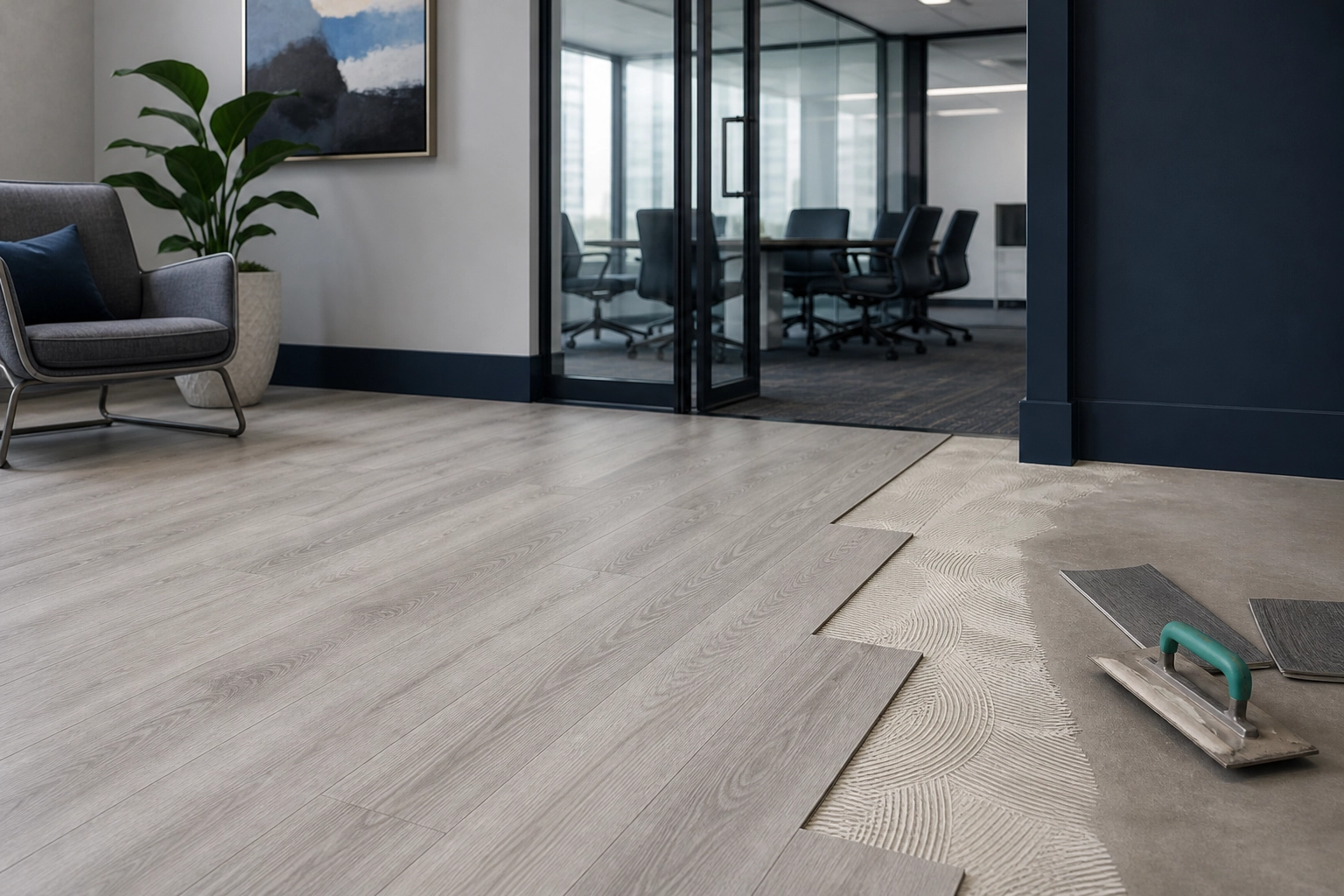
Failures often surface weeks or months after installation, after the installer has left. In vinyl flooring commercial projects, that timeline is not bad luck. Glue-down luxury vinyl plank in commercial spaces fails at the seams for a short list of predictable reasons: the wrong adhesive for the slab, moisture above the system's allowance, flatness outside the manufacturer's requirement, or traffic before the adhesive cures. This analysis walks through a teardown of curled edges, opened seams, and tenting, then turns each failure into a spec line a written scope should state. You will read why glue-down LVP fails at the seam first, five specific failure modes, how rolling loads drive zoning decisions, and what a Metro Atlanta scope should include and exclude. Final Floors, LLC works on commercial LVP and subfloor preparation across Metro Atlanta. The goal is simple: fix each issue on paper, where it is cheaper than in a leased space.
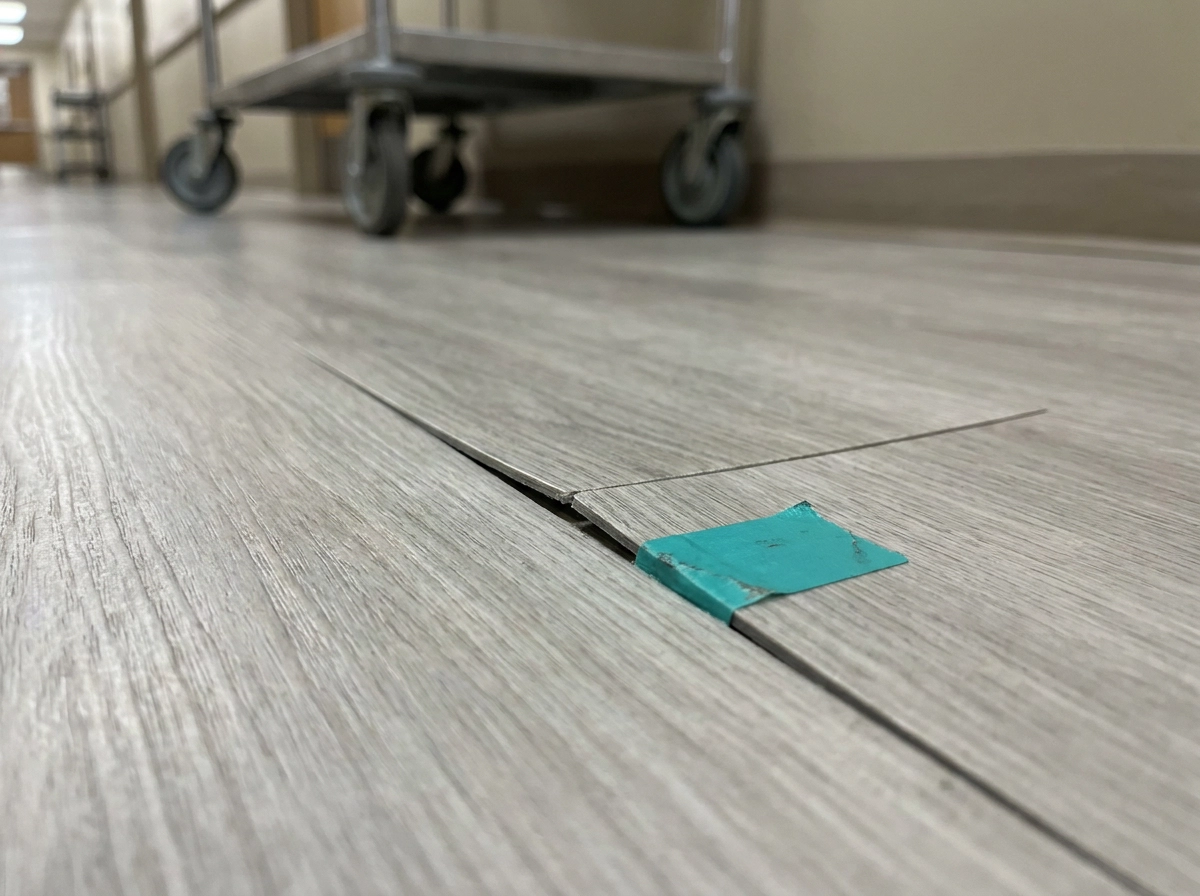
Why Glue-Down LVP Fails at the Seam First in Commercial Spaces
Glue-down LVP is the specified system where carts, gurneys, and pallet jacks roll. Shaw's guidance requires full glue-down in rolling-load corridors (covered in Failure 5).
Seams concentrate stress. Each joint is where adhesive bond, slab flatness, and slab moisture meet, so a weak bond or low spot shows first as an opened seam or lifted edge, not mid-plank wear. Failures often surface weeks or months after installation, after the installer has left.
Curling edges usually trace to adhesive that never bonded along the plank edge, or to plank edges rocking on slab deviation, separate from wear layer thickness.
Four of the five causes here, adhesive, moisture, flatness, and traffic release, become spec lines before mobilization and must be verified on the product sheet. The fifth, rolling load, decides whether glue-down fits the zone at all. The cheapest commercial vinyl flooring bids often exclude the testing and correction line items that prevent these failures, so scope outweighs square-foot price.
Failure 1: The Wrong Adhesive for the Slab and the Product
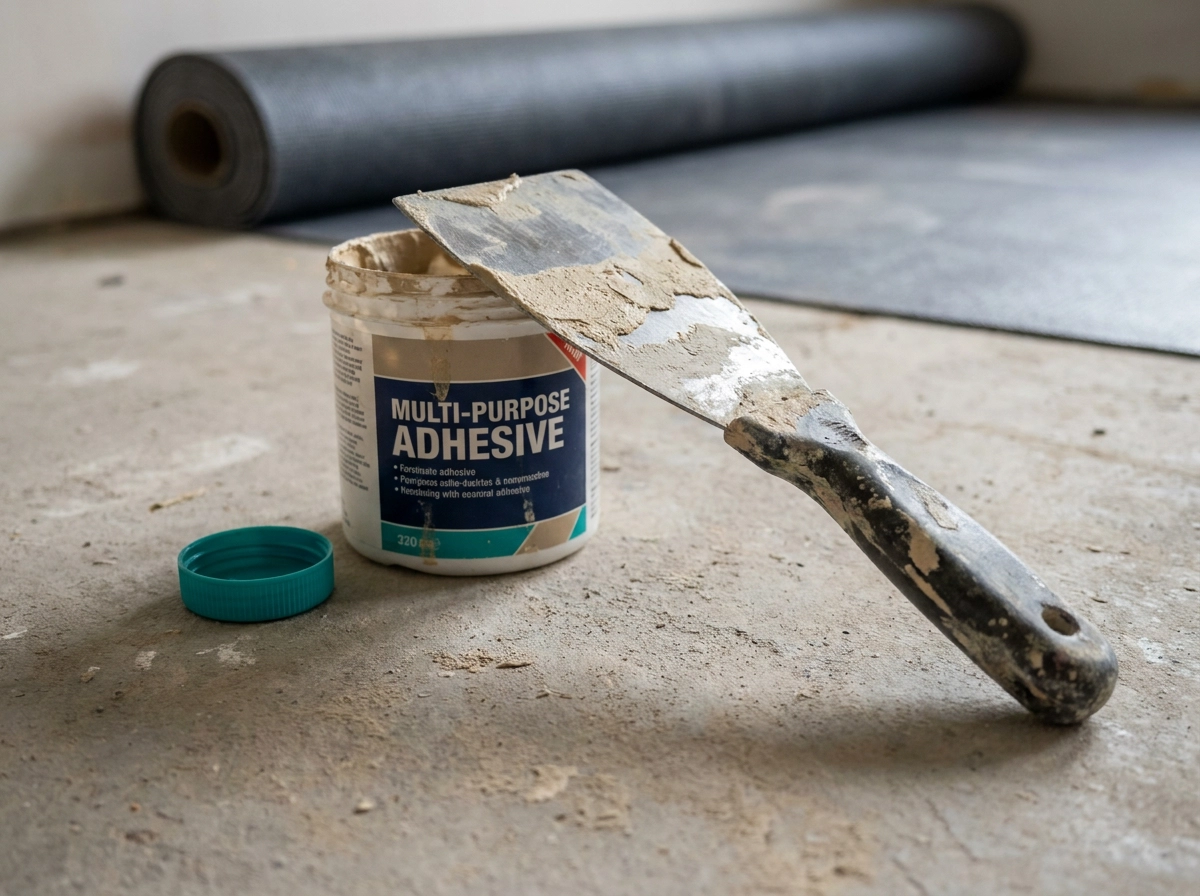
"We always use the same adhesive" is a habit, not a spec. The product sheet names the approved adhesive for that backing and slab, with spread rate and trowel notch. An unapproved adhesive can void the warranty before the first cart rolls.
Shaw requires a bond test for adhesive compatibility, an on-site check that plank, adhesive and prepared slab hold together. Shaw also calls crumb rubber underlayments unacceptable; a cushion cannot substitute for subfloor repair and leveling.
Open time runs differently in an occupied Metro Atlanta suite than on a quiet site. Adhesive that flashes off or is applied with the wrong trowel notch may leave plank edges under-bonded; those edges are vulnerable to lifting under traffic.
Spec line: name adhesive by manufacturer and product number, trowel notch, spread rate, open time and bond test. An unnamed adhesive lets the installer substitute.
Failure 2: Slab Moisture Above the System's Allowance
Adhesive is half the bond; slab moisture is the other half.
ASTM F2170 measures in-situ relative humidity; ASTM F1869 measures calcium chloride MVER. Both describe method only. The manufacturer sets the acceptance limit for the specific system.
Confirm the product-specific limits, test methods, and frequency directly from the current product sheet before ordering material; limits vary by plank and adhesive system.
Most manufacturer warranties require dated, ASTM-referenced test results; without documentation, a moisture claim may be difficult to support regardless of the actual cause. See also Water-Damage Flooring Replacement in Atlanta.
Adhesive data sheets set the governing limits; a product marketed as tolerating high humidity still carries a documented threshold on its sheet, and that threshold controls.
Spec line: test methods, product-sheet limits, frequency, who tests, who receives the report before material is ordered.
Failure 3: Flatness Outside the Manufacturer's Requirement
Flatness follows the same product-specific logic. Glue-down LVT needs continuous adhesive contact along the plank: a high spot pivots it, a low spot voids it.
Verify the flatness tolerance on your product's sheet; one commonly cited benchmark is approximately 3 mm per 1.8 m straightedge for glue-down LVT, but the number that controls is the one on the current product data sheet, confirmed against ASTM F710.
Measure with a straightedge in multiple directions, never by eye or a level on a high spot. Put the method in the scope; it settles arguments later.
Corrections include grinding, patching, self-leveling and subfloor repair, adding time, dust control, cost and pre-rent schedule risk. Slab joints, patched trenches and old adhesive residue drive much of that deviation, so scope patch and joint treatment, not the slab generally. Ask what can change this luxury vinyl plank flooring scope when reviewing a bid.
Spec line: flatness tolerance, straightedge method, who verifies and corrects, how corrections are priced, and what happens when deviations surface after installation begins.
Failure 4: Traffic Before the Adhesive Cures
The cure window comes off the adhesive sheet, adjusted for jobsite temperature and humidity. A Metro Atlanta suite with doors propped open to summer air cures differently than a conditioned room. In a working restaurant, retail space or office, pressure to reopen early puts furniture, carts, cleaning equipment and pallet traffic on fresh adhesive. That breaks a bond which never gets a second chance. If tenant, GC and contractor each assume another controls access, the floor gets loaded early.
Spec line: state the adhesive cure time, the time before full foot traffic, separate timing before rolling loads and furniture, who protects the floor during the window, and how the release time appears on the construction schedule. Timing governs every schedule.
Failure 5: Rolling Loads and the Zoning Decision
Rolling loads decide what cure timing cannot: whether glue-down is right for the zone. Shaw's guidance requires full glue-down in corridors or areas subject to rolling loads. Specifying click-lock in a hospital corridor, grocery aisle, or stockroom run is wrong before first plank is placed.
Current industry practice increasingly uses hybrid zoning -- glue-down LVT in high-traffic public areas and click-lock SPC in functional back-of-house zones -- but this is a project-by-project decision, not a published standard. Wear layer is one factor in zone selection; confirm the traffic classification and adhesive requirements on the current product sheet. Click-lock installation moves faster, which matters during tenant turns.
Spec line: name the system by zone, glue-down or click-lock, state the traffic assumption behind each, and define transitions where systems meet, as you would in a carpet installation in Metro Atlanta scope.
Curled Edges and Opened Seams: Reading the Teardown
Sources on commercial resilients cover tenting and debonding but say less about curled edges and opened seams. Read both as outcomes of three inputs: adhesive condition, slab moisture, slab flatness. Our diagnostic read, not a quoted rule.
Curled edge: adhesive starved or applied incorrectly at the plank perimeter never bonds fully; the edge lifts and traffic opens the joint (see Failure 1).
Opened seam: slab deviation lets planks rock across the joint, the edge bond fails, grit loads the gap until it reads from standing height.
Tenting: moisture movement or an adhesive compatibility problem drives expansion against a fixed point like a perimeter or casework toe kick, so perimeter allowance belongs in the written detail.
Diagnostic order: pull a plank, read adhesive transfer, compare moisture records to the product sheet limit, measure flatness across the seam. Without dated test records, a warranty claim may be difficult to support. Photograph the pulled plank and transfer pattern; it separates material, moisture, prep and timing issues.
The Spec Lines That Prevent Each Failure
Every line below belongs on one written page a superintendent can check against the slab, not scattered across product literature.
Adhesive: approved adhesive by product number, trowel notch and spread rate, plus a required bond test before general installation so compatibility is verified on site.
Moisture: confirmed product-sheet limits, test methods and frequency (see Failure 2), with dated results before material is ordered.
Flatness: the tolerance and straightedge method, who corrects deviations, and correction priced as its own line so it cannot vanish from a bid.
Cure and traffic: cure time, full traffic release time, rolling load and furniture timing, and who controls access during the window.
Zoning and rolling loads: glue-down or click-lock by zone, the traffic assumption behind each choice, perimeter expansion and transition details.
Verification owner: name the verification owner in the scope -- the installer should confirm testing is complete and results are acceptable before installation begins, regardless of who performed the test. Name that owner in the scope so it is not left to the GC to assume.
One document also keeps what can change a commercial flooring scope visible when the project shifts.
What a Written Scope Should Include and Exclude
That page holds the lines; the scope sets boundaries.
Include: the spec lines from each failure section form the include list; add removal and disposal, warranty terms and acclimation.
Exclude: moisture mitigation beyond scope; after hours or emergency scheduling; furniture moving; protection after release; undisclosed slab corrections found after installation begins.
"Install per manufacturer instructions" delegates every decision to install day, when the slab is covered and material is on site. Ask for numbers, and for what can change a flooring scope.
Access and phasing belong in writing: after hours windows, dock and elevator time, staging, odor and dust rules, occupied square footage.
For condos and multi tenant buildings, confirm association or landlord rules on adhesive, noise hours and protection; they often collide with the cure window.
Metro Atlanta Items to Verify Locally
No reviewed source addresses Metro Atlanta humidity, local slab-on-grade practice, or construction schedules; treat them as project items to verify, not universal rules, and say so in the scope review.
Georgia slab-on-grade reads differently by season. A dry-month test does not describe the slab after an August rain cycle, so ask when it was taken and under what conditions.
Tenant build-outs compress: rent commencement squeezes moisture testing, flatness correction, and cure windows, which is how an opened seam gets built in. HVAC status matters: unconditioned air shifts adhesive open time, cure time, and acclimation, so confirm what runs and when.
Verify moisture, flatness, acclimation, adhesive, stair, warranty, and return-to-use requirements on the live specifications, and request those pages in the bid package, not a verbal summary.
Roswell-based Final Floors installs commercial vinyl flooring across Atlanta, Buckhead, Midtown, Roswell, Alpharetta, Sandy Springs, Marietta, East Cobb, Duluth, Peachtree Corners, and nearby areas, and can walk a slab and schedule before ordering.
What Drives Cost When You Fix It on Paper Instead of in a Leased Space
Repair cost follows the verification list: plank removal and disposal, adhesive and residue removal from the slab, moisture mitigation, flatness correction, replacement material, after-hours labor, and revenue lost while the space is out of service.
On paper, each is a bid line. In a leased space, it brings a second mobilization, repeat demolition, lost trading hours, tenant relocation, and a landlord argument over who pays.
The scale of concrete moisture problems in commercial construction is significant; treat any single industry figure as directional context rather than a budget number, and price from the actual scope.
Bid comparison is the lever: the lower commercial vinyl flooring bid often omits moisture testing, flatness correction, adhesive specification and after-hours work. Compare line by line, not price per square foot. A warranty that requires dated, ASTM-referenced moisture results is only as strong as the documentation in the file.
Final Floors writes free project-specific estimates from the slab, zone and schedule, verifying requirements on the current product sheet, not a universal tolerance.
FAQs About Glue-Down LVP in Commercial Spaces
What opens glue-down LVP seams? Adhesive that never bonded, slab moisture above the sheet limit, flatness outside tolerance, or traffic before cure. Often two at once; records matter as much as plank.
Can moisture-tolerant flooring skip testing? No. The sheet sets limits; warranties still require dated, ASTM-referenced results.
How soon can furniture and rolling loads return? The adhesive data sheet sets the window, adjusted for site temperature and humidity; confirm the specific cure and traffic-release times on the current product sheet before scheduling tenant return.
Is click-lock acceptable in a commercial corridor? Shaw requires full glue-down for corridors and rolling loads. Current industry practice increasingly uses hybrid zoning -- glue-down LVT in high-traffic public areas and click-lock SPC in functional back-of-house zones -- but this is a project-by-project decision, not a published standard.
What should I send for an estimate? City and area, existing floor, square footage by zone, slab and failure photos, plus access, after-hours and rent commencement constraints. Then a contractor prices scope, not square footage.
Next Step: Put the Numbers in Writing Before the Slab Is Covered
Glue-down LVP seam failures trace to predictable causes: wrong adhesive, moisture above the system's allowance, flatness past the manufacturer's requirement, or traffic before cure. Each has a product-specific spec line, cheaper on paper than in a leased space.
Send your city, existing floor, square footage by zone, and photos of the slab and failed seams. We walk the slab, confirm moisture, flatness, adhesive and cure requirements on your product's sheet, and give you a free project-specific estimate with inclusions and exclusions in writing. Call 770-910-9719, text 770-870-9876, or request a free estimate. Start with the flooring project match.
Conclusion
Glue-down LVP seam failures in Metro Atlanta commercial spaces are predictable and preventable -- each failure traces to a spec line that is cheaper on paper than in a leased suite.