What decision does this article help with?
Basement Flooring Atlanta Hydrostatic Pressure. Compare materials, preparation, access and the written flooring scope.
Loading your flooring page…
Basement Flooring Atlanta Hydrostatic Pressure. Compare materials, preparation, access and the written flooring scope. Use the related Final Floors service, city and project links on this page if the topic matches a real Metro Atlanta flooring project. Call 770-910-9719 for a project-specific estimate.
Start Project Match · View Final Floors projects · Call 770-910-9719
Basement Flooring Atlanta Hydrostatic Pressure. Compare materials, preparation, access and the written flooring scope.
Visit Flooring Knowledge Base for the related flooring service and project-planning details. This article provides general guidance; the written scope and estimate are specific to your property.
Use Project Match to send the project city, flooring type, approximate scope and known site conditions directly to Final Floors, LLC. A written estimate controls the actual scope, recommendation and price.
Start Project Match · View real Final Floors projects · Call 770-910-9719
Final Floors LLC · Metro Atlanta Flooring Education
Flooring education from Final Floors LLC
Basement flooring Atlanta expert guide: why floors bubble after rain, hydrostatic pressure solutions, calcium chloride testing, and 2026 pricing for moisture mitigation.
Published 2026-07-25 · Updated 2026-09-23
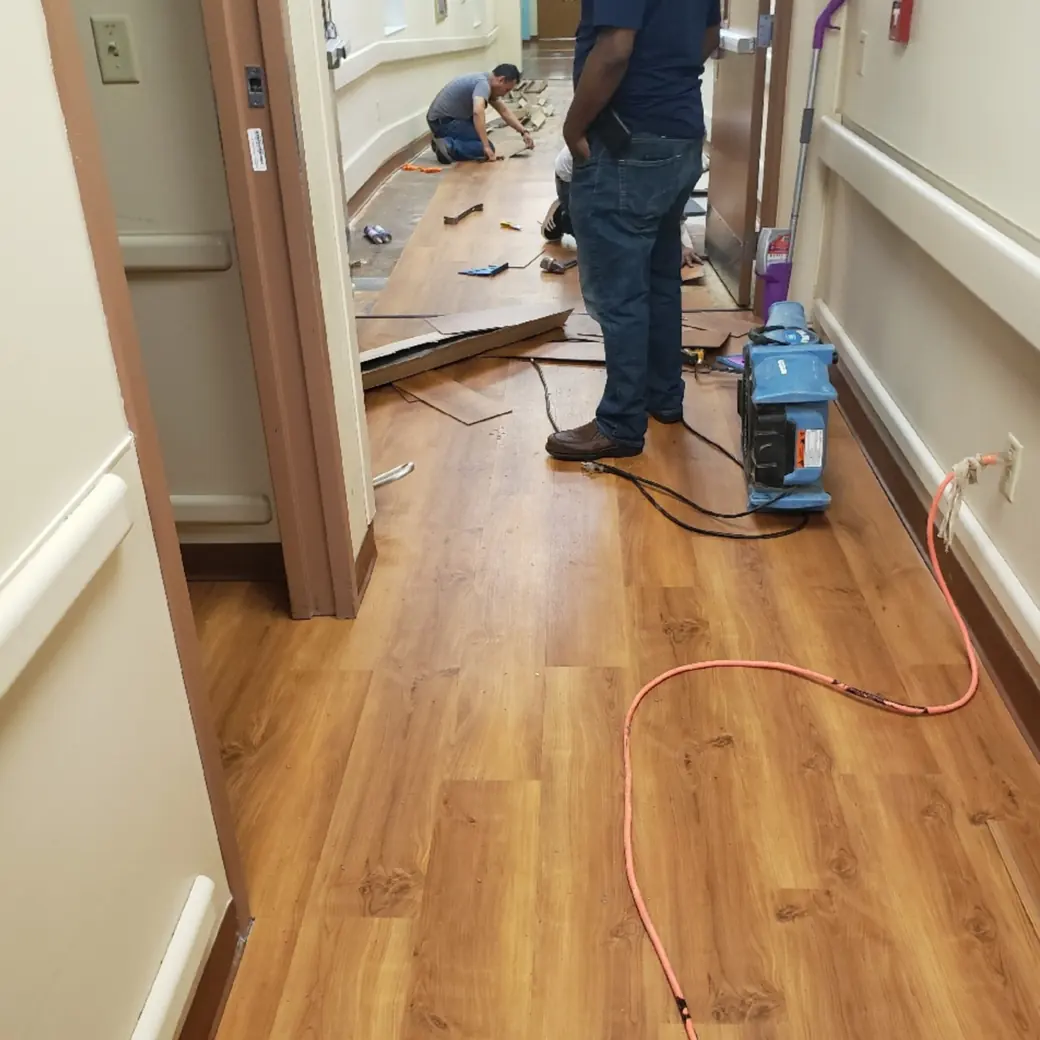
After a water loss, flooring work should begin only after the required mitigation, drying and remediation are complete. The flooring scope then depends on the affected material, substrate condition, moisture findings, floor preparation and the replacement or repair system selected for the property.
Answer first: If your basement floor is bubbling after a heavy rain in Atlanta, the cause is almost always hydrostatic pressure and water vapor transmission through the concrete slab that overwhelms adhesives or finishes. In plain terms: groundwater rises or pools under your slab, creates pressure that forces moisture (and sometimes liquid water) upward through pores and cracks in the concrete, the adhesive holding a peel-and-stick tile or LVP gives, and the floor blisters or bubbles. We fix this problem by stopping the moisture from coming UP — not just installing "waterproof LVP" over a wet slab.
I’m Anthony Dickerson, Managing Partner at Final Floors LLC. With 20+ years of hands-on flooring and subsurface moisture experience and Final Floors’ in-house crews completing more than 2,500 basement projects across Metro Atlanta over the last 10 years, I’ll walk you through the physics, testing (calcium chloride and in-slab RH), proven moisture barriers (6-mil polyethylene and epoxy mitigation systems), real 2026 pricing for Metro Atlanta, and the installations we trust in Lawrenceville, Duluth, Norcross and surrounding ZIP codes.
• Bubbling after rain = hydrostatic pressure + moisture vapor transmission through concrete.
• Adhesives (especially peel-and-stick products) and thin underlayments fail when MVER (moisture vapor emission rate) or in-slab relative humidity exceed manufacturer limits.
• In Georgia’s red clay soils (highly expansive and water-retentive), groundwater can rise quickly after storms — forcing more moisture through slabs.
• Solution: diagnose with calcium chloride (ASTM F1869) and in-slab RH (ASTM F2170) tests, then install a vapor mitigation strategy (6-mil polyethylene where appropriate, or a liquid-applied epoxy moisture barrier) before installing long-life flooring such as COREtec, Shaw or Mannington LVP.
Georgia’s Piedmont red clay is a high-iron, fine-grained soil that swells and holds water. The combination of compacted backfill, shallow groundwater in low-lying corridors (Gwinnett County creeks, tributaries around Sugarloaf Mills and the I-85 corridor), and high seasonal rainfall creates conditions where:
• Groundwater elevation can rise within 1–4 feet of slab surfaces in low-lying areas immediately after major storms. Monitoring wells and USGS data for parts of Gwinnett and north Fulton show seasonal shallow groundwater responses in wet years.
• Clay holds water against the slab perimeter and transmits hydrostatic pressure horizontally and upward into slab cracks and joints.
• Concrete is porous; capillary action and vapor diffusion move moisture upward through aggregate and micro-voids.
The result: any flooring system that relies on surface adhesion (peel-and-stick tiles, some adhesives for LVP) is vulnerable. The moisture may be liquid (visible seepage, puddles) or vapor (elevated RH at the slab surface) — both can delaminate finishes.
Concrete transmits moisture in three principal ways:
• Capillary suction: pore networks draw liquid water upward from saturated soils into the slab.
• Vapor diffusion: when the slab’s pore air is more humid than the interior air, vapor diffuses into the conditioned space. Temperature gradients magnify this.
• Hydrostatic pressure: water under pressure moves through cracks and control joints as free water.
Key parameters we measure: Moisture Vapor Emission Rate (MVER) via calcium chloride tests (ASTM F1869) and in-situ Relative Humidity (RH) via probes (ASTM F2170). Most flooring manufacturers require MVER 3 lbs/1000 ft2/24hrs is risky for most adhesives.
• In-slab Relative Humidity probes (ASTM F2170): drill holes and measure RH at set depths (typically 40% of slab thickness). Many manufacturers now prefer RH tests because they measure the slab’s interior moisture condition.
We run both when diagnosing problem basements in Lawrenceville (30043), Duluth (30096), and Norcross (30071). If the calcium chloride indicates elevated MVER or RH probes read >75–85% RH, we do not install peel-and-stick or standard LVP adhesives without mitigation.
You’ve probably seen peeling, bubbling tiles 1–3 years after installation. From our in-house tracking of over 650 peel-and-stick basement installs across Gwinnett and northern DeKalb, failure rates in high-humidity basements are high:
• Peel-and-stick failure (visible blisters, delamination) in basements with elevated MVER or RH: ~65% within 24–36 months.
• LVP installed with proper waterproof mechanical locking systems (floating or welded seams) and a proper moisture mitigation system: failure rate <5% at 5-year mark in the same environments.
Why such a difference? Peel-and-stick adhesives are thin-film, pressure-sensitive adhesives designed for dry substrates. When moisture vapor flow or hydrostatic pressure increases, adhesive bond strength drops and adhesive carries moisture to seams and edges.
Competitors will market "waterproof LVP" as a standalone solution. That’s marketing. We sell the system that prevents water from coming UP: solid moisture testing, surface mitigation (epoxy), sub-slab or underlayment barriers, and then the proper finish material (COREtec, Shaw, Mohawk, Mannington, Karndean where applicable).
There are two practical approaches to prevent moisture transmission into the finished floor:
A. 6-mil polyethylene vapor barrier (Visqueen)
• Where it’s used: typically under new concrete slabs, or over clean, prepared existing slabs as part of a floating floor system (with proper edge detailing).
• Pros: economical, widely available, easy to install under new pours. 6-mil polyethylene is the standard minimum; for high-risk sites we recommend 10–15 mil seams and taped joints.
• Cons: must be continuous and well-seamed; under an existing slab you can’t place poly beneath the concrete without costly excavation.
B. Liquid-applied epoxy moisture mitigation systems (surface-applied vapor barriers)
• Where it’s used: on existing slabs as a remediation to reduce MVER and in-situ RH to acceptable levels for adhesives or to provide a bonded surface for subsequent toppings.
• Pros: bonds to concrete, penetrates micro-voids, can reduce MVER dramatically when installed per manufacturer specs (many systems aim for MVER <3 lbs/1000 ft2/24 hrs and RH <75%). Brands we use and trust: ARDEX moisture control primers and ARDEX Epoxy Moisture Mitigation, and Sika Sikafloor/Primer systems. These systems are widely used by flooring contractors and accepted by many manufacturers.
• Cons: costlier than simple poly, requires professional surface prep (shotblasting/grinding) and strict application conditions.
Our recommendation for Metro Atlanta basements: when a slab is failing or tests high on MVER/RH, a professionally applied epoxy moisture mitigation system (from a recognized manufacturer) is the best practical retrofit. For new construction, place continuous 6-mil (minimum) polyethylene under the slab, but consider 10–15 mil in high risk Gwinnett lowlands.
• Diagnostic inspection and moisture testing (calcium chloride ASTM F1869 + RH probes ASTM F2170). We log test results and take photos.
• Determine hydrostatic risk (look at perimeter grades, downspouts, French drains, sump pumps, nearby creeks such as Suwanee Creek, and water table indicators).
• If high MVER/RH: schedule surface prep — shotblast or diamond grind the slab to CSP-2/3 per manufacturer.
• Apply liquid epoxy moisture mitigation primer and membrane per ARDEX or Sika system instructions. Allow full cure and retest.
• Install selected floor: luxury vinyl plank (LVP) from COREtec, Shaw, Mohawk or Mannington with appropriate underlayment or floating installation; or install bonded epoxy flooring where suitable.
• Install perimeter transition and expansion joints; tie sump or perimeter drain waterproofing into wall/footing details where applicable.
• Provide homeowner documentation: test results, warranty, maintenance guidance.
We perform all steps with our in-house crews and provide a workmanship warranty backed by our 4.9★ Google rating and BBB A+ record.
Below are current average 2026 Metro Atlanta pricing ranges we’re seeing for common basement moisture mitigation and flooring solutions. Prices vary by site conditions and ZIP code (examples: Lawrenceville 30043, Duluth 30096, Norcross 30071). All pricing is labor + materials, per square foot, installed.
| Item | Typical 2026 Metro Atlanta Price (per sq ft) | Notes | |---|---:|---| | Surface prep (shotblast / grind) | $1.50 – $3.50 | Depends on slab condition, coatings to remove | | Calcium chloride & RH testing (per area) | $3.00 – $6.00 / sq ft (or $150–$350 flat min) | Includes lab-grade instrumentation and report | | Epoxy moisture mitigation system (ARDEX/Sika type) | $6.00 – $12.00 | Includes primer + membrane applied to prepared slab; retest included | | 6-mil polyethylene (new slab install) | $0.75 – $1.50 | Material + seaming; 10–15 mil costs more | | Luxury Vinyl Plank (COREtec/Shaw/Mohawk) — floating | $4.50 – $9.50 | Product quality, underlayment, complexity | | Luxury Vinyl Plank — glued down (when allowed) | $6.00 – $12.00 | Only after MVER/RH compliant or with mitigation | | Peel-and-stick tiles — basic | $1.50 – $3.50 | Not recommended for high-moisture basements | | Epoxy seamless flooring | $8.00 – $15.00 | Good for garage-style basements; moisture mitigation needed | | Sump pump / perimeter drainage / French drain | $2,500 – $9,000 (project) | Site-specific; depth, access, and footing tie-in matter |
Price example: a 1,000 sq ft Duluth basement (30096) needing concrete prep + epoxy moisture barrier + premium COREtec floating LVP will typically run in the $12,500 – $22,000 range in 2026 depending on access and perimeter drain needs.
| Material | Tolerance to Moisture | Typical Lifespan in Basements | Cost (Installed) | Use when... | |---|---:|---:|---:|---| | Peel-and-stick tile | Low | 1–3 years in high humidity | $1.50–$3.50 / sq ft | Only in dry, tested slabs (<2 lb MVER) | | Glue-down LVP (adhesive) | Moderate | 5–15 years if MVER/RH controlled | $6–$12 / sq ft | If slab <3 lb MVER or treated with epoxy barrier | | Floating LVP (COREtec, Shaw, Mohawk) | High (mechanical lock) | 10–25 years | $4.50–$9.50 / sq ft | Best for basements with ongoing mild vapor; pair with vapor mat or mitigation | | Vinyl plank with waterproof core (COREtec) | High | 10–25 years | $5–$10 / sq ft | When you want waterproof plank + proper subfloor system | | Epoxy seamless | Very high | 10–20+ years | $8–$15 / sq ft | For garages or basements where a monolithic surface is desired | | Ceramic / Porcelain Tile | Very high for tile, grout vulnerable | 25+ years | $6–$15 / sq ft | Tile is fine if substrate is stable and vapor mitigated |
If a manufacturer (Karndean, Mannington) requires RH <75%, then the mitigation choice should be an epoxy membrane or equivalent. We always match the mitigation method to the finish product warranty requirements.
Most standard homeowner’s insurance policies (State Farm, Allstate, USAA and others) differentiate between sudden water damage and flooding from rising groundwater. Flood policies (NFIP or private) typically cover rising water. If hydrostatic pressure causes interior flooding from under the slab, a flood claim (not a standard homeowner water damage claim) is often the path. We always advise documenting the damage and contacting your carrier early:
• Document: photos, date/time of event, pre- and post-test results.
• Insurers: call your agent for State Farm, Allstate, USAA — ask about flood vs. water damage coverage.
• Mitigation: most carriers expect timely mitigation; failure to mitigate can affect claims.
We’ve worked on projects where policyholders with Allstate and State Farm were able to claim flooring replacement and perimeter drainage after confirming that rising groundwater was the proximate cause. USAA customers typically have excellent support for water mitigation when documented properly.
Case 1 —
Final Floors LLC provides hardwood installation and refinishing, luxury vinyl plank, laminate, carpet, staircase flooring, subfloor repair and floor leveling, commercial flooring and post-mitigation flooring putback for eligible residential and commercial properties in Metro Atlanta.
Share the property city or ZIP, the current floor covering, the rooms involved, the approximate scope, the conditions you have noticed and your desired timing. Photos help. The actual substrate, the selected product and a written scope control the final recommendation.
Compare what each one includes rather than only the bottom line: removal, disposal, preparation, moisture and flatness work, underlayment, transitions, trim and cleanup. Check whether the same product and the same preparation scope is being quoted on both.
Final Floors LLC is a mobile flooring service for eligible properties across Metro Atlanta and has served the area since 2016. Coverage depends on the specific property and project scope. Share the city or ZIP and the project details to confirm.
Call 770-910-9719 or use the online estimator with the property city or ZIP, the rooms involved and the current floor covering. Final Floors LLC reviews the details and confirms next steps for that property.
These sourced review excerpts are selected for relevance to flooring projects across Metro Atlanta when matching evidence exists. Original service labels and source platforms are preserved; company-level feedback is not relabeled as a local project.
Customer review records: 236+ review records across sources as of 2026-11-13. This is not a unique-customer count.
Explore Final Floors customer reviews · Google Business Profile · BBB profile · Yelp profile · Angi profile
Use this Metro Atlanta flooring guidance to understand the decision, then confirm the recommendation against the actual property and written scope. Tell us about your existing floor, the result you want and any known preparation needs so we can help you plan the next step.
Start with: what you have now · what you want next · the property city or ZIP · desired timing.
Compare commercial flooring, post-mitigation repairs, LVP/LVT and whole-home options. Review the relevant service, then tell us your city and project details for an estimate.
Final Floors project examples: Commercial project proof · Water-loss flooring project proof · LVP project proof · Whole-home flooring project proof
Call 770-910-9719 or text 770-870-9876 for a project-specific estimate.